The Presumption of Parental Involvement Is Being Repealed.
Here's What It Actually Means for Fathers.
SUMMARY The UK government is repealing the "presumption of parental involvement", the part of the Children Act 1989 that tells family courts to assume a child benefits from both parents being involved. The repeal does not remove fathers' rights, parental responsibility or the chance of a good child arrangements order. It removes a starting assumption, so the court looks only at what this particular child needs. For fathers, that makes the quality, consistency and safety of your involvement matter more than ever.
QUICK ANSWER The repeal of the presumption of parental involvement means family courts in England and Wales will no longer start from the assumption that both parents' involvement is good for a child. Each case will be judged on the child's welfare alone. Contact is not being abolished and parental responsibility is unchanged. Safe, consistent, child-focused parenting is still what the court is looking at.
If you're a father who has just read that the government is "scrapping the presumption of contact" and your stomach dropped, read this before you text anyone, post anything or call a solicitor in a panic.
The presumption of parental involvement repeal is real. It is going through Parliament now. And most of what is being said about it in comment sections, dads' forums and WhatsApp groups is wrong. This is not the day the law turned against fathers. What it does is change what the court pays attention to. Once you understand that, you can stop reacting to the headline and start preparing for what the court will actually look at.
That's what this post is for.
What is the presumption of parental involvement?
DEFINITION: Presumption of parental involvement A rule in section 1(2A) of the Children Act 1989, added in 2014, which tells family courts to presume, unless there is evidence to the contrary, that involvement of each parent in a child's life will further that child's welfare. In plain terms: the court's starting point was "both parents being involved is probably good for this child", unless someone showed otherwise.
The presumption was introduced by the Children and Families Act 2014. It was meant to push separating parents away from all-or-nothing positions and signal that children usually do better with both parents in their lives.
Three things about it are widely misunderstood:
It never meant 50/50. "Involvement" can mean direct or indirect contact. The law was explicit that it was not about any particular division of time.
It never guaranteed contact. It could be displaced by evidence that a parent's involvement put the child at risk of harm.
It was always subordinate to the welfare principle. The child's welfare was, and remains, the court's paramount consideration.
The Ministry of Justice's own review, published in October 2025, found that the presumption was rarely relied upon in judgments. Judges were already deciding cases on the welfare checklist and, where abuse was alleged, on Practice Direction 12J.
In short: the presumption was a starting assumption, never a guarantee of contact, and it was rarely the deciding factor in court.
Why is the UK repealing it?
The repeal follows years of evidence about how family courts handle domestic abuse.
In 2020, the Ministry of Justice's expert panel on harm in the family courts (often called the Harm Panel) reported a "pro-contact culture": courts prioritising contact with both parents even where there were allegations or findings of abuse. It recommended an urgent review of the presumption.
The government's review of the presumption was published on 22 October 2025. It found that unsupervised, face-to-face involvement is the most common outcome in child arrangements applications, including in cases involving allegations or findings of domestic abuse. It concluded that the presumption appeared to reinforce that pro-contact culture, and the government announced it would be repealed.
Much of the drive for change came from Claire Throssell MBE. Her sons, Jack and Paul, were killed by their father in 2014 after a court allowed him unsupervised contact. She campaigned for a decade for this change.
The repeal sits alongside a wider set of reforms, including the national roll-out of Child Focused Courts (formerly the "Pathfinder" pilot). These courts gather information early, listen to children directly and produce a Child Impact Report, rather than moving families through hearing after hearing.
DEFINITION: Child Focused Courts A reformed model of private family law proceedings in England and Wales, formerly piloted as "Pathfinder". It uses an investigative, problem-solving approach, earlier information gathering, and a Child Impact Report prepared by Cafcass or the local authority, with greater emphasis on hearing the child's voice. In plain terms: the court finds out more about your child earlier, and listens to your child more.
In short: the repeal is a response to evidence that courts were ordering contact with abusive parents. It is not a verdict on fathers as a group.
What changes and what doesn't
Here's where the panic comes from, and why most of it isn't warranted.
What changes
The court no longer starts from the assumption that both parents' involvement benefits the child.
The court makes an open-minded inquiry into what this particular child needs.
In practice, the burden sits more squarely on showing, through evidence and behaviour, that your involvement is good for your child.
What does not change
The welfare principle. The child's welfare remains the court's paramount consideration (section 1(1) Children Act 1989).
The welfare checklist. The court still weighs the child's wishes and feelings, their physical, emotional and educational needs, the likely effect of any change in their circumstances, any harm they have suffered or are at risk of, and how capable each parent is of meeting their needs (section 1(3)).
Parental responsibility. If you have it, you keep it.
Your ability to apply for a child arrangements order.
The fact that most children still benefit from a safe, loving relationship with both parents. The law has not decided otherwise. It has only stopped assuming it in advance.
Put more simply: the presumption was never doing much for the father who is safe, consistent and involved. It was doing a great deal for the parent who wasn't safe, because it gave them a head start they had not earned.
If you are the safe parent, the repeal takes nothing from you.
In short: the repeal removes a head start, not a right. The welfare checklist, parental responsibility and your ability to apply to court all remain.
"So is this anti-father?"
I understand why it feels that way. I work with men every week who are frightened that leaving the relationship means losing their children. When a headline says "contact presumption scrapped", that fear goes straight to the nervous system, and a frightened nervous system is bad at reading the detail.
Here is the reframe I give the men I work with.
Your case was never going to be won by a presumption. It is decided on what your child needs and whether you can meet those needs. That was true before the repeal and it is true after.
The men who come out of family proceedings well tend to be the ones who stopped fighting about principle and started showing, consistently and in writing, who they are as a parent. They stay regulated when provoked. They know their child's teacher, GP appointments, medication, friends and bedtime. When they message the other parent, they write about the child, not about the relationship.
That is the parent a welfare-based court is looking for, and the repeal makes it more visible.
COMPOSITE EXAMPLE (details combined from several clients and changed to protect confidentiality) He read the news at 1am and had drafted three furious messages to his ex before breakfast. We didn't send any of them. Instead, we built a plain record: the school runs he did, the parents' evenings he attended, the reading log he signed every night his son was with him. Six weeks later, that record was worth more than any argument about his rights.
In short: a welfare-based court judges the parent you show it you are. Regulated, involved and child-focused is the strongest position you can be in.
Why neurodivergent children need routine and a secure base
All children need stability and routine. For neurodivergent children, it is essential, and it adds another layer to why this repeal matters even more for them than it would for a neurotypical child.
Here's why. Without the presumption, the court no longer begins with a general assumption about what children need. It asks what this child needs. For a neurodivergent child, the answer to that question is shaped by their need for predictability, consistency and a place of safety. Those needs now sit closer to the centre of the court's thinking, where they belong.
This is the part of the conversation almost nobody is having, and for many families it will matter more than the repeal itself.
DEFINITION: Neurodivergent A term for people whose brains develop or work differently from what is considered typical, including autistic people and people with ADHD, dyspraxia, dyslexia and related conditions. In plain terms: a child whose brain processes the world differently, often with a greater need for predictability.
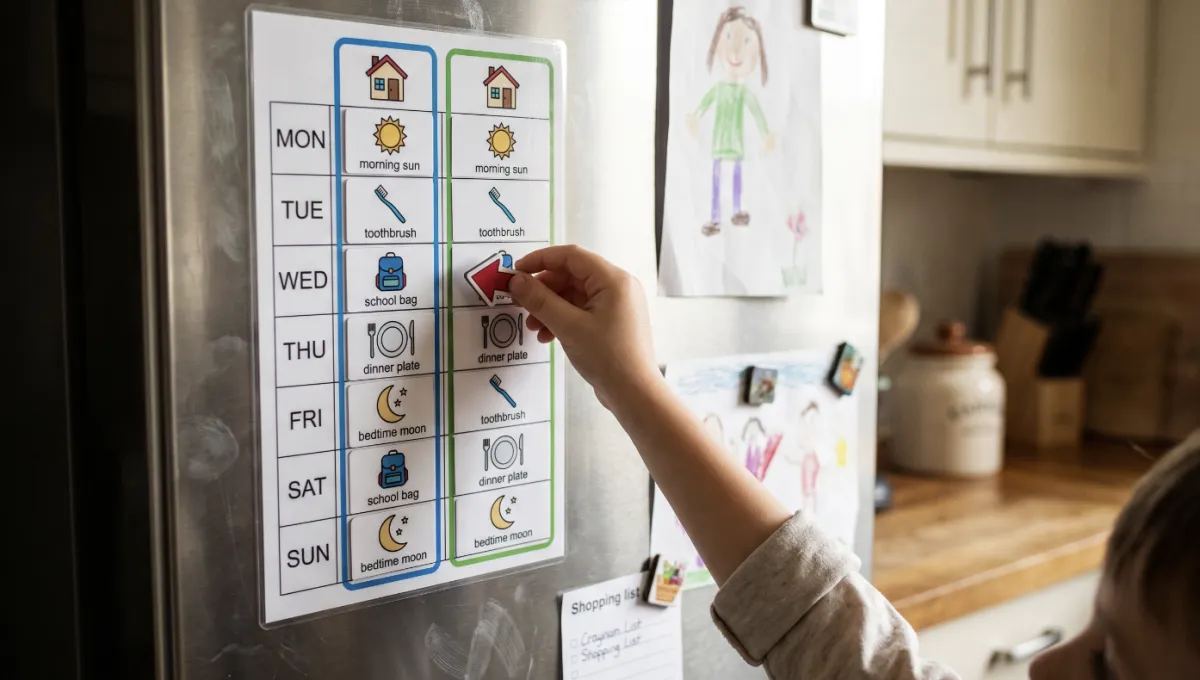
DEFINITION: Secure base A concept from attachment theory describing the caregiver a child returns to for safety and regulation, and explores the world from. In plain terms: the person your child goes to when the world gets too much.
For most children, change is hard. For many neurodivergent children, and autistic children in particular, unpredictability doesn't just upset them. It overwhelms them. The National Autistic Society explains that routines help autistic people reduce anxiety, manage energy, regulate and cope with change. Unplanned changes can cause significant distress.
Now think about what separation asks of that child. Two homes. Two sets of rules. Handovers, a different bed, a different journey to school, a bag packed by someone else, a PE kit that is in the wrong house on the wrong day.
In my clinical experience, neurodivergent children tend to orient strongly towards one main caregiver: the parent they experience as their safest place. That parent is where they regulate, where they rest and where they feel most themselves. Research supports the idea that autistic children form genuine attachments to their caregivers, and attachment theory has long described children organising their sense of safety around a primary figure.
In my view, the parent who is the child's secure base should usually hold the greatest share of the child's time, especially in term time. That is where the child's structure, stability and routine live. School already asks a neurodivergent child to spend all day managing noise, demands, social rules and transitions. What gets them through the school week is a predictable evening, the same bedtime, the same breakfast and the same person at the end of the day.
This fits the welfare checklist the court already applies. It asks the court to weigh the child's emotional and educational needs and the likely effect on them of any change in their circumstances. For a neurodivergent child, a split designed around fairness to the adults rather than the child's nervous system can be a significant change in circumstances.
If you are the main caregiver
Say so clearly and back it with evidence: who manages the school communication, the EHCP or SEN support, the appointments, the sensory needs, the meltdowns and the recovery afterwards. Many fathers are the primary caregiver and don't say so, because they assume the court won't believe them. Document it.
If you are not the main caregiver
This is the harder message, and the one I think will help your child most.
Fighting for an equal split of a neurodivergent child's school week can cost the child more than it gains you. The strongest thing you can do is become their second secure base:
Mirror the routine. Same bedtime, same wind-down, same breakfast, same screen rules wherever you can agree them.
Protect school nights. Build your time around what the school week can tolerate, and make weekends and holidays count.
Make handovers boring. Same time, same place, same short script, no adult conversation in front of the child.
Keep their world in both homes. Duplicate the comfort objects, the ear defenders and the favourite cup. Nothing important should travel in a bag that can be forgotten.
Prepare them for every change. Visual timetables, calendars and advance warning. Never surprise a neurodivergent child with an arrangement change you could have flagged.
A child who feels safe in your home will want to be there. That lasts longer than any order.
In short: neurodivergent children need predictability more than most, and they tend to organise around one secure base. Arrangements should protect that, especially in term time, and the other parent's job is to become a second place of safety.
What should you do now?
If you are separating, or already in proceedings, this is where to put your energy:
Stop reading the comment sections. They are full of fear and very short on law. Get your information from a family solicitor and reputable sources.
Build a record of your involvement. School, health, activities, routines. Dates and specifics, not adjectives.
Write every message as if a judge will read it. Brief, informative, friendly and firm. Nothing about the relationship. Everything about the child.
Regulate before you respond. A reaction sent at midnight can undo months of calm parenting. Wait until you are calm, then reply.
Put your child's needs at the centre of your proposal. Especially if your child is neurodivergent: build the plan around their routine, not around the calendar.
In short: the repeal changes nothing about what makes a strong parent in court. Consistency, calm and evidence always have.
Where is the Bill now?
The repeal is contained in the Courts and Tribunals Bill. It had its Second Reading in the House of Commons on 10 March 2026, was reintroduced in May 2026 and has been progressing through report stage. It still needs to pass the House of Lords and receive Royal Assent, and the change must then be brought into force.
Until then, section 1(2A) remains law. Check the current position with a family law solicitor before relying on it in your own case.
In short: the repeal is coming, but at the time of writing it is not yet in force.
Frequently asked questions
Does the repeal of the presumption of parental involvement mean fathers will lose contact?
No. The repeal removes the court's starting assumption that both parents' involvement is good for the child. It does not remove contact, parental responsibility, or your right to apply for a child arrangements order. Courts will still decide cases on the child's welfare using the welfare checklist, and most children still benefit from a safe relationship with both parents. What changes is that involvement is no longer assumed at the outset. It is judged on the evidence of what this particular child needs.
When will the presumption of parental involvement be repealed?
The repeal is part of the Courts and Tribunals Bill, which had its Second Reading on 10 March 2026 and has been going through report stage. It still needs to complete its passage through Parliament, receive Royal Assent and be brought into force. Until then, section 1(2A) of the Children Act 1989 remains in effect. Check the current status with a family law solicitor before relying on it.
Does this mean 50/50 shared care is less likely?
The presumption never meant 50/50. It concerned "involvement", which could be direct or indirect, and the law was explicit that it did not require any particular division of time. Shared care arrangements remain possible and are decided, as before, on the child's welfare. For some children, particularly neurodivergent children who need predictability, an equal split of the school week may not be what serves them best.
I'm a safe, involved dad. Should I be worried?
The repeal is aimed at cases where a parent's involvement puts a child at risk. If you are safe, involved and child-focused, the welfare-based approach already favours what you bring. The practical step is to make your involvement visible: keep a record of the school, health and daily care you provide, keep your communication with the other parent brief and child-focused, and take legal advice early.
How should arrangements work for an autistic or ADHD child after separation?
Neurodivergent children need more predictability than other children, and many organise their sense of safety around one main caregiver. Arrangements that protect a consistent term-time routine, keep handovers simple, mirror routines across both homes and prepare the child in advance for any change are usually easier for the child to manage. The court already considers the child's emotional and educational needs and the likely effect of any change in circumstances.
What is the difference between the presumption and the welfare checklist?
The presumption (section 1(2A)) was a starting assumption that each parent's involvement benefits the child. The welfare checklist (section 1(3)) is the list of factors the court must weigh, including the child's wishes and feelings, needs, the effect of change, any risk of harm and each parent's capability. The presumption is being repealed. The welfare checklist stays, and it was always the more important of the two.
Is this post legal advice?
No. This post explains the proposed change and its emotional and practical impact on fathers and families. It is not legal advice and it is no substitute for advice from a qualified family law solicitor about your own circumstances.
You don't have to face this in panic mode
If this change has you lying awake, going over what it means for you and your children, that response makes sense. But decisions made in fear are rarely the ones that serve your child. I work with a small number of parents at a time, helping them stay regulated, child-focused and strategic through separation and high-conflict co-parenting.
Book a consultation and we'll talk through your situation in depth, confidentially, over Zoom.
Rebecca P. FoxPsychotherapist | Educator | Author
IMPORTANT This article is for educational purposes only. It is not legal advice and is not a substitute for therapy or for advice from a qualified family law solicitor about your circumstances. The law described here was going through Parliament at the time of writing and may change. If you are in crisis or feel unable to keep yourself safe, call Samaritans free on 116 123, any time, day or night. If you or your children are in immediate danger, call 999.
References
Children Act 1989, sections 1(1), 1(2A) and 1(3). legislation.gov.uk. https://www.legislation.gov.uk/ukpga/1989/41/section/1
Ministry of Justice (2025). Review of the Presumption of Parental Involvement: Final Report. https://assets.publishing.service.gov.uk/media/68f5f5c206e6515f7914c7e3/Review_of_the_Presumption_of_Parental_Involvement_Final_Report_.pdf
UK Parliament (22 October 2025). Family Justice: Better Protections for Children, Written Ministerial Statement HCWS979. https://questions-statements.parliament.uk/written-statements/detail/2025-10-22/hcws979
Ministry of Justice (2020). Assessing Risk of Harm to Children and Parents in Private Law Children Cases: Final Report (the "Harm Panel" report). https://www.gov.uk/government/consultations/assessing-risk-of-harm-to-children-and-parents-in-private-law-children-cases
GOV.UK (7 March 2026). Government moves to protect children from abusive parents through new Courts and Tribunals Bill. https://www.gov.uk/government/news/government-moves-to-protect-children-from-abusive-parents-through-new-courts-and-tribunals-bill
House of Commons Library. Courts and Tribunals Bill (research briefing CBP-10515). https://commonslibrary.parliament.uk/research-briefings/cbp-10515/
Graham, N. (31 July 2026). "Presumption of parental involvement repeal." Law Society Gazette. https://www.lawgazette.co.uk/practice-points/presumption-of-parental-involvement-repeal/5127556.article
Courts and Tribunals Judiciary (17 March 2026). Judges welcome roll-out of Child Focused Courts. https://www.judiciary.uk/judges-welcome-roll-out-of-child-focused-courts/
National Autistic Society. Preference for order, predictability or routine. https://www.autism.org.uk/advice-and-guidance/about-autism/preference-for-order-predictability-or-routine
Rutgers, A. H., Bakermans-Kranenburg, M. J., van IJzendoorn, M. H., & van Berckelaer-Onnes, I. A. (2004). Autism and attachment: a meta-analytic review. Journal of Child Psychology and Psychiatry, 45(6), 1123–1134. https://pubmed.ncbi.nlm.nih.gov/15257669/
Bowlby, J. (1988). A Secure Base: Parent-Child Attachment and Healthy Human Development. Basic Books.


