Body Dysmorphia vs BDD: The Difference and How to Heal
Summary Body dysmorphia and Body Dysmorphic Disorder (BDD) are often used to mean the same thing, but they aren't. One is painful insecurity about your appearance; the other is a diagnosable mental health disorder that can take over your life. This piece explains the difference, why neither is gender-specific, where these struggles come from including their strong link to childhood trauma and abuse, and why full recovery is genuinely possible.
Quick answer Body dysmorphia is distorted or distressing dissatisfaction with your appearance that comes and goes and doesn't disable you. Body Dysmorphic Disorder (BDD) is a clinical disorder recognised in the DSM-5, where obsessive, intrusive thoughts about a perceived flaw take over your thinking, behaviour and daily functioning. The simplest test: does it stop you living your life? If yes, it may be BDD.
Most people have days where they feel insecure about their appearance. A bad hair day. A breakout. An outfit that just doesn't sit right. Moments like this are human. But for some, the relationship with their appearance goes beyond insecurity. It becomes obsessive, intrusive, overwhelming, a mental loop that takes over every part of life.
And before we go any further, it's important to clear up one very common misconception: body dysmorphia and Body Dysmorphic Disorder are not gender-specific.
While society often portrays these struggles as "women's issues," men experience them deeply too and often with even greater stigma. BDD does not discriminate. It affects all genders, all ages, and all backgrounds. This is why understanding the difference between body dysmorphia and Body Dysmorphic Disorder matters so much. While the terms are used interchangeably online, they are not the same and knowing the difference can be the first step towards recognising what you're truly experiencing, and how to heal from it.
What is body dysmorphia?
Body dysmorphia refers to a distorted perception of, or dissatisfaction with, one's appearance, without it becoming a clinically diagnosable mental health disorder.
Think of it as an umbrella term that covers:
Feeling unhappy with specific features
Comparing yourself to others
Fixating on your "flaws" during low-confidence periods
Feeling uncomfortable being seen without makeup, filters or certain clothing
Definition of body dysmorphia Body dysmorphia is distorted or distressing dissatisfaction with your appearance that does not meet the threshold for a clinical disorder. It tends to be situational and comes and goes. In plain terms: its painful, but not paralysing.
Key characteristics: it's distressing but not disabling; it's often situational (triggered by a breakup, puberty, weight changes, social media); it doesn't completely take over your daily functioning; and you can still work, socialise and engage in life.
In short: Body dysmorphia is distorted, painful dissatisfaction with your appearance that comes and goes and still lets you live your life, while it's distressing, it's not disabling.
What is Body Dysmorphic Disorder (BDD)?
Body Dysmorphic Disorder is a clinical mental health disorder that goes far deeper than insecurity and profoundly affects how a person thinks, feels, behaves and functions. People with BDD experience obsessive, intrusive thoughts about their appearance, often about perceived "defects" that others don't notice, or don't see at all.
Definition for Body Dysmorphic Disorder (BDD) BDD is a diagnosable mental health disorder, classified in the DSM-5, involving obsessive preoccupation with a perceived flaw in appearance that others can't see or consider minor that drives compulsive behaviours and significant distress or impairment. In plain terms: not insecurity you can shake off, but a disorder that hijacks your life.
Hallmark signs of BDD include:
Obsessive focus on a perceived physical flaw (skin, nose, hair, body shape)
Ritualistic behaviours such as mirror-checking, picking, grooming or seeking reassurance
Avoidance behaviours such as refusing to be in photos, avoiding social events, hiding behind clothes, hats or heavy makeup
Belief distortion - thinking your appearance is "wrong," "abnormal" or "unfixable"
Impaired functioning where missing work, cancelling plans, or refusing to leave the house becomes the norm
Compulsive comparison to others
Frequent cosmetic consultations or procedures that rarely relieve the distress
In BDD, the anxiety is extreme. The thoughts are consuming. The emotional distress is often unbearable.
And let's be clear about something vital: BDD is not vanity. No one with this disorder is admiring themselves. They're not obsessed because they love how they look - they're obsessed because they believe they're fundamentally flawed. This is not insecurity or attention-seeking. This is torment. BDD is one of the deepest, most painful expressions of internal self-hatred.
In short: BDD is a diagnosable disorder where obsessive, intrusive thoughts about a perceived flaw drive compulsive rituals and take over daily life. It isn't vanity; it's extreme torment.
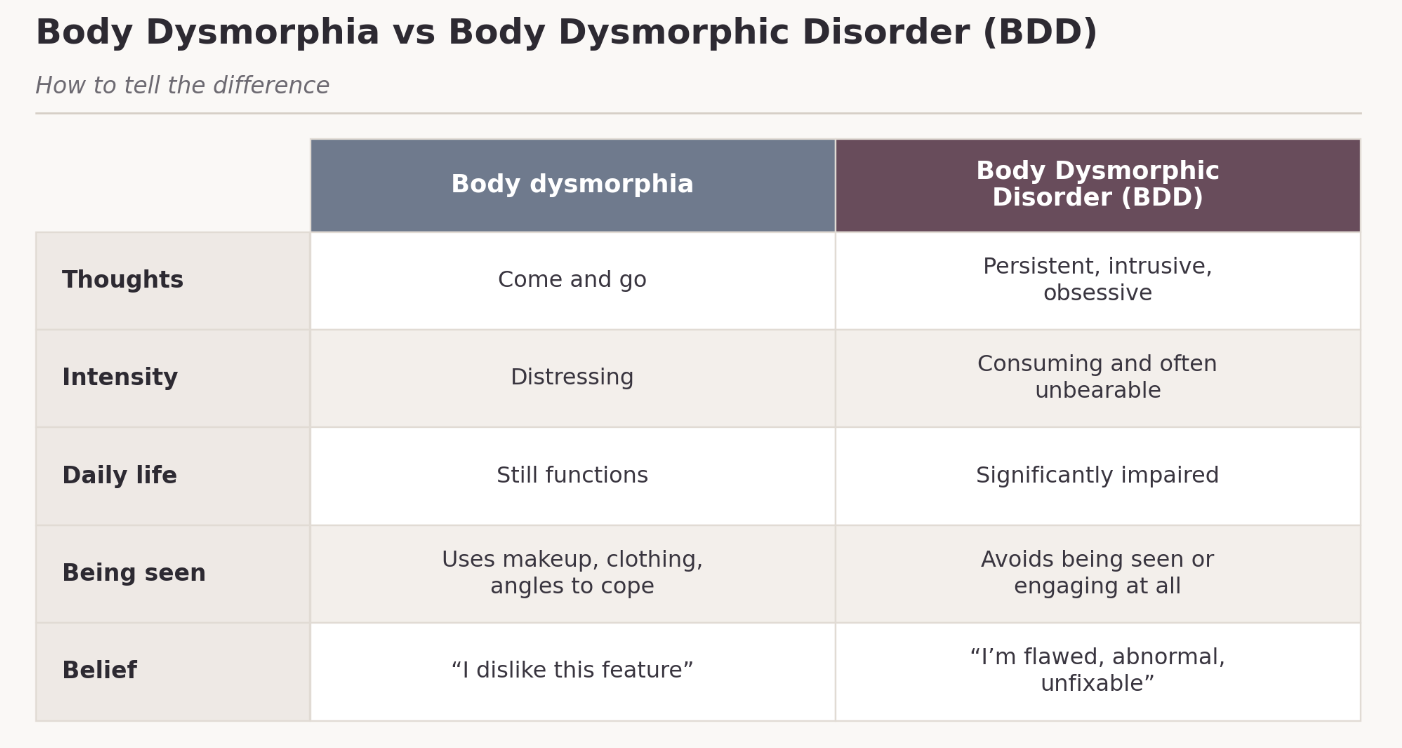
If you're unsure which one applies to you, ask yourself: "Does this impact my ability to live my life on a daily basis?" If the answer is yes, it may be BDD.
In short: Body dysmorphia is dislike of your appearance that you can still function around; BDD is obsessive, intrusive preoccupation that impairs your daily life. The dividing line is whether it stops you living.
I used to have a whole ritual whenever I attempted to go out - if I even made it that far. An hour on makeup. Thirty minutes on hair. Then the real battle began: standing in front of the mirror for what felt like forever, cycling through eight different outfits, obsessively analysing which one made me look the "least fat." If, after all of that, nothing made me look "better," I simply wouldn't go. I'd cancel, stay home, cry… and most of the time, punish myself with binge eating. It became a relentless cycle - exhausting, isolating and completely consuming. Those were the days when I was incredibly unreliable, not because I didn't care, but because I genuinely couldn't bear to be seen.
These conditions affect far more than what you see in the mirror. They influence how you think, feel, behave and connect with the world.
The four areas BDD affects most
Emotionally
Anxiety (constant fear of being judged or "seen"), depression (feeling hopeless or defeated by the battle with your reflection), shame (a deep sense that "something is wrong with me," often tied to childhood wounds), exhaustion (mental and physical burnout from the rituals and avoidance), and isolation (pulling away from people because being seen feels unbearable).
Behaviourally
Rituals (mirror-checking, grooming, skin-picking, angle-testing, reassurance-seeking), avoidance (cancelling plans, skipping events, avoiding photos), excessive grooming, over-exercising driven by fear rather than health, and compulsive comparison to everyone around you.
Relationally
Fear of intimacy (worrying that up close, someone will confirm your "flaws"), sabotaging dating (ghosting or refusing to date because you feel unworthy), believing you're "not attractive enough," and feeling disconnected from loved ones because so much energy goes into the battle with your appearance.
Professionally
Missing work on "bad appearance days," struggling to focus through intrusive thoughts, avoiding career opportunities that mean being "seen," and hiding during meetings or video calls.
BDD reaches far beyond the mirror. It shapes your confidence, your relationships, the risks you take, and the future you believe is possible. To loosen its grip, we have to look at its roots.
In short: BDD doesn't stay in the mirror - it reaches into your emotions, your behaviour, your relationships and your work, shaping the whole shape of your life.
The psychological roots of body image distortion
Body dysmorphia and BDD don't appear out of nowhere. They're shaped by experiences that condition the brain to believe that appearance equals worth.
1. Childhood experiences. Many people who develop body image distortions grew up in environments where appearance was criticised, compared, monitored, mocked, praised excessively, or linked to love and acceptance. A parent commenting on your weight, being told "you'd be so pretty if…," a highly critical caregiver, being bullied about how you looked. When a child learns their body is something to fix, hide or perfect, that belief grows up with them.
2. Trauma, shame and emotional neglect. BDD often emerges in people who experienced emotional rejection, parental inconsistency, abuse or neglect, or feeling unseen and unimportant. For many, obsessing over the body becomes a survival strategy - a way to manage emotional pain that feels too overwhelming to face. The body becomes the one thing you believe you can control, and that's often where disordered eating takes root too. Because the struggle is never really about how you look - it's about the belief that you're not enough.
3. Social media and modern beauty culture. Filters, editing, cosmetic enhancement, "perfect" influencers, highlight reels. You no longer compare yourself only to people in your community - you compare yourself to the best angle, best lighting and most edited version of millions of strangers. That constant exposure distorts reality and amplifies perceived flaws.
4. Perfectionism and high-achievers. BDD often affects people-pleasers, perfectionists and overachievers with low self-worth and high self-criticism, because the belief "I must be perfect to be accepted" extends naturally to the body.
When the root is childhood abuse, and narcissistic abuse in particular
This is where my work with trauma meets this condition head-on, and it's the part I most want you to understand.
The link between body image distortion and childhood abuse isn't a hunch, it's well evidenced. In one widely cited study, nearly four in five people with BDD (78.7%) reported a history of childhood maltreatment, with emotional neglect and emotional abuse the most common types of all. A 2022 meta-analysis of more than 9,000 people confirmed adverse childhood experiences as a risk factor for body dysmorphic symptoms.
Now sit that alongside what narcissistic abuse actually is. Narcissistic abuse in childhood is a form of emotional abuse and it does something specific: it distorts a child's sense of self and their grip on reality. When a caregiver's love runs hot and cold, when your worth is made conditional and often tied to how you look or perform, you learn that you're only acceptable when you're "perfect." The shame that belonged to the abuser gets absorbed by the child and, with nowhere else to go, is frequently projected onto the body. The body becomes the thing to fix because the real wound, the belief that you are not enough, feels far too big to touch.
Definition of narcissistic abuse Narcissistic abuse is a pattern of emotional abuse - criticism, control, conditional love, and the distortion of reality (including gaslighting) - usually by a caregiver or partner, that erodes a person's sense of self and self-worth. In plain terms: being treated in ways that teach you your worth is conditional, and made to doubt your own reality.
Seen this way, body dysmorphia is rarely about the body at all. It's frequently a symptom, a by-product of trauma that happened long before the mirror ever became the enemy. Which is also why lasting change so often has to start there: not with the reflection, but with the wound underneath it.
In short: Research links BDD strongly to childhood maltreatment, especially emotional abuse and neglect and narcissistic abuse is exactly that kind of environment. It distorts a child's sense of self and ties their worth to being "perfect," so the shame lands on the body. Body dysmorphia is often a symptom of earlier trauma, not a flaw in the body.
The good news: healing isn't only possible, it's proven
Recovery is real, and it's well understood. Healing typically includes therapy (CBT, trauma work, somatic work), correcting the distorted thinking patterns around appearance, understanding the emotional root causes, gently reducing compulsive behaviours (often with exposure work), strengthening self-worth from the inside out, and rebuilding a safe, compassionate relationship with your body. With the right support, people recover fully and stay recovered.
In short: BDD is treatable. With trauma-informed therapy, cognitive and exposure work, and self-worth rebuilt from the root, people recover fully and stay recovered.
A snippet from my story: from BDD prison to 10 years of freedom
I lived with Body Dysmorphic Disorder for years and it didn't just steal my confidence, it shaped how I moved through the world. It dictated every part of my day, every decision, every breath I took in front of a mirror. It drained the joy out of moments that were supposed to be happy. And if I'm honest, I believe it's one of the reasons I fell into a toxic relationship that almost cost me my life.
For me, the roots of it clearly go back to childhood - growing up with a narcissistic mother who was obsessed with weight. I could be told I looked "too fat" and "too skinny" in the same week and sometimes in the same day. I never knew what the "right" version of me was supposed to look like. Some days she'd beam at strangers and call me "lovely," and other days she'd look straight at me and call me a "greedy little cow." It was emotional chaos… and when your appearance is treated like a moving target in childhood, it becomes a source of confusion and shame in adulthood.
My first experience of love reflected that same instability. It was volatile, abusive, and completely rooted in how I looked. The criticism of my weight, my face, my body it wasn't new. It almost felt familiar, like slipping into a role I'd been trained for my entire life. Heartbreaking as it is to admit, it felt normal. It felt like home. And I accepted it because somewhere deep inside, I believed that abuse was what I deserved.
I carried this belief that if I could just stay perfect - slim enough, quiet enough, disciplined enough, then maybe I'd finally be good enough. Maybe the abuse would stop. But the truth is, BDD is never satisfied. No amount of changing your body ever heals the wound underneath. And being in a toxic relationship only magnified it. My abuser exploited my disorder in every way he could, using it to keep me small, scared and trapped.
It wasn't until I went through therapy and did real, deep, trauma-informed work that things finally began to shift. I learned how much of my self-hatred came from emotional wounds rather than physical features. I learned how to regulate the intrusive thoughts that once ran my life. And I slowly learned to see myself through kinder, more compassionate eyes.
Today, I've been free from BDD for almost an entire decade. That freedom is possible for you too. Healing isn't loving everything at once, it's reconnecting with yourself and letting go of the fears and beliefs that once ruled you. And do you know what's remarkable about my journey? Today I'm the heaviest I've ever been - yet I'm also the happiest and most at peace I've ever been in my body. Mirrors aren't something I hide from anymore. I welcome them.
If what you've read here touches something in you, please hear me: this doesn't have to be your life. With the right therapist or practitioner - someone who truly understands BDD, trauma and disordered eating, healing is possible. This is the work I do, and if you'd like to talk about where you are, you can book a call with me through my website. I found my way back to myself, and you can too. 💖
Rebecca
Frequently asked questions
What's the difference between body dysmorphia and Body Dysmorphic Disorder (BDD)? Body dysmorphia is distorted, distressing dissatisfaction with your appearance that tends to come and go and still lets you function. BDD is a diagnosable disorder in the DSM-5, where obsessive, intrusive thoughts about a perceived flaw drive compulsive behaviours and significantly impair daily life. The simplest test is whether it stops you living your life - if it does, it may be BDD.
Is BDD a mental illness? Yes. Body Dysmorphic Disorder is a recognised mental health disorder, classified in the DSM-5. It is not vanity, insecurity or attention-seeking - it involves genuine, often unbearable psychological distress and can seriously affect a person's functioning, relationships and safety.
Is body dysmorphic disorder the same as vanity? No it's almost the opposite. Someone with BDD isn't admiring themselves; they're tormented by the belief that they're fundamentally flawed. The preoccupation is driven by self-hatred and shame, not self-love.
Do men get body dysmorphia and BDD? Yes. BDD is not gender-specific. Men experience it too, often silently and with greater stigma, and it can centre on muscularity, hair, skin, or specific features. Because it's so often framed as a "women's issue," many men go unrecognised and unsupported for years.
What causes body dysmorphia and BDD? There's no single cause, but common roots include childhood experiences where appearance was criticised or tied to love, trauma and emotional neglect, the comparison culture of social media, and perfectionism. Research links BDD particularly strongly to childhood emotional abuse and neglect.
Is there a link between childhood abuse and body dysmorphia? Yes. Studies consistently find high rates of childhood maltreatment among people with BDD - one widely cited study found nearly 79% reported a history of abuse or neglect, with emotional abuse and neglect the most common. Narcissistic abuse, a form of emotional abuse that distorts a child's sense of self and worth, is exactly this kind of environment, which is why body dysmorphia is so often a symptom of earlier trauma rather than a problem with the body.
Can you recover from BDD? Yes. BDD is treatable, and full recovery is possible. Trauma-informed therapy, cognitive and exposure work, and rebuilding self-worth from the root help people move from obsession to peace and stay there.
About the author
Rebecca P. Fox Psychotherapist | Educator | Author. Rebecca helps people recover from toxic and abusive relationships, childhood and relational trauma, and the self-image wounds that trauma leaves behind. She writes from both clinical training and lived experience of recovery.
This article is educational and isn't a substitute for therapy, diagnosis or medical advice. If you're struggling, you don't have to face it alone. In the UK you can contact Samaritans free, day or night, on 116 123; the BDD Foundation (bddfoundation.org) offers specialist information and support for body dysmorphic disorder; and Beat (beateatingdisorders.org.uk) supports anyone affected by an eating disorder.
References
American Psychiatric Association. (2013). Diagnostic and Statistical Manual of Mental Disorders (5th ed., DSM-5) — classification of Body Dysmorphic Disorder.
Didie, E. R., Tortolani, C. C., Pope, C. G., Menard, W., Fay, C., & Phillips, K. A. (2006). Childhood abuse and neglect in body dysmorphic disorder. Child Abuse & Neglect, 30(10), 1105–1115. https://pubmed.ncbi.nlm.nih.gov/17005251/
Adverse childhood experiences and body dysmorphic symptoms: A meta-analysis. Body Image (2022). https://www.sciencedirect.com/science/article/abs/pii/S1740144522000043


