Can Childhood Trauma Create a Narcissist?
What the Research Really Tells Us
Could the narcissist you know have once been a deeply wounded child?
It's a question that makes people uncomfortable. When you've been on the receiving end of narcissistic abuse, the last thing you may want to hear is that the person who harmed you was once vulnerable themselves. But understanding how narcissism develops isn't the same as excusing it, and the research gives a far more nuanced answer than most conversations allow.
So, can childhood trauma cause narcissism? Not on its own, and not inevitably. What the evidence increasingly shows is that childhood maltreatment, neglect, emotional abuse and insecure attachment are meaningful risk factors in the development of pathological narcissism, particularly vulnerable narcissism. That matters, because if we understand what happens before narcissistic traits become entrenched, we have a far greater chance of intervening early.
Narcissism doesn't begin in adulthood
We tend to talk about narcissism as though it appears fully formed in adulthood. As though one day someone suddenly becomes entitled, controlling and unable to tolerate criticism, and we reach for the label " narcissist." But personality doesn't switch on at 30, 40 or 50. It develops over time, through thousands of experiences and relationships that teach us who we are, what we can expect from other people, and how safe it is to be vulnerable.
So when we see narcissistic behaviour in an adult, we're looking at the end of a long developmental story. Somewhere along the way, that person learned particular ways of protecting themselves and holding on to a sense of self. That doesn't excuse the harm they cause, but it does mean that to understand how narcissism develops, we have to look much further back than the moment the label first gets used.
A child's early experiences shape how they come to answer a set of quiet, formative questions - not consciously, but through repeated experience:
Am I safe?
Am I lovable?
Can I trust other people?
Will someone be there when I need them?
What happens when I have needs, or make a mistake?
Do I have to earn love?
These are lessons the developing nervous system absorbs through relationships. When those early relationships are marked by fear, humiliation, neglect, inconsistency or rejection, a child can learn something very different from "I am safe, I am worthy, I can trust people." They may learn instead that vulnerability is dangerous, love is conditional, and their needs are a problem. Repeated over time, those lessons become embedded in how the child understands themselves and everyone around them.
Narcissism isn't one thing: the narcissistic spectrum
Before we go further, I want to highlight a distinction that gets lost online: not everyone who shows narcissistic behaviour has Narcissistic Personality Disorder. Narcissism exists on a spectrum.
We all have narcissistic traits. We all want recognition at times, care how others see us, get defensive, or struggle with criticism. That's part of being human. The problem arises when those traits become rigid, pervasive and damaging. At the far end of the spectrum, someone can meet the criteria for Narcissistic Personality Disorder (NPD). There's a real difference between having a few narcissistic traits and having a narcissistic personality style, having pathological narcissism, and meeting the diagnostic threshold for NPD, these aren't interchangeable.
Researchers also distinguish two presentations, and the difference matters for everything that follows:
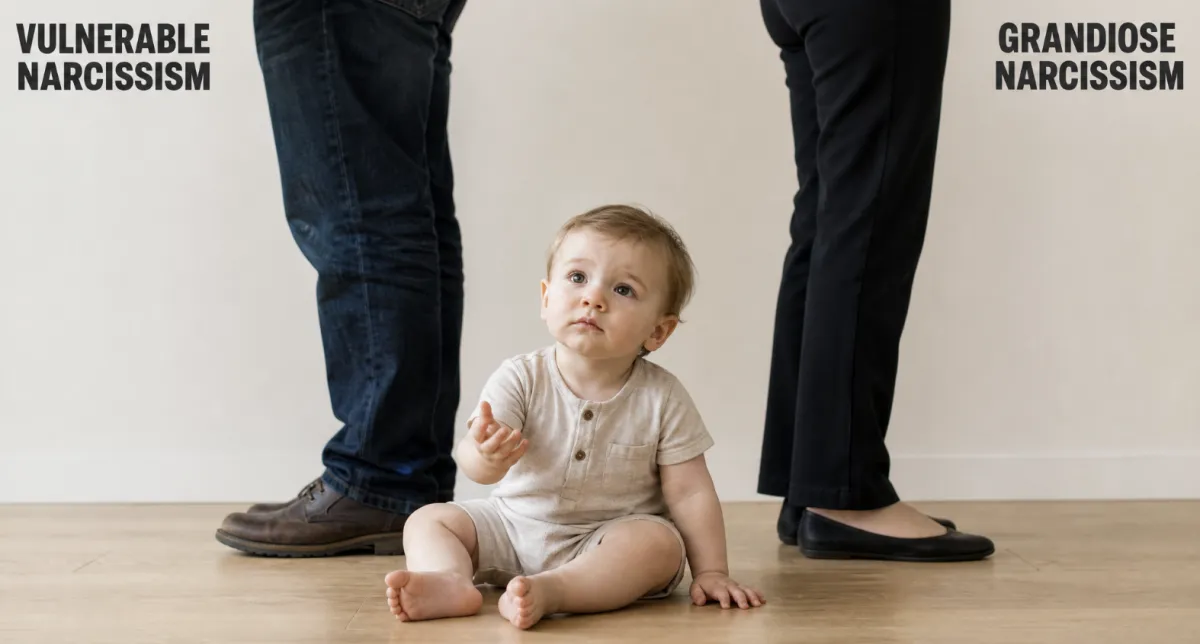
Grandiose narcissism - the version most people recognise: superiority, entitlement, dominance, exploitation, attention-seeking and an inflated sense of importance.
Vulnerable narcissism - often very different on the surface: hypersensitivity to criticism, insecurity, shame, feelings of inadequacy, social withdrawal, self-esteem that depends on external validation, and intense reactions to perceived rejection.
This matters because the research on childhood experience points most strongly towards the vulnerable presentation.
What the research actually shows
Let's be clear about the part that gets distorted most: childhood trauma does not automatically create narcissistic personality disorder. Not every abused child becomes narcissistic, and not every narcissistic adult was abused. Personality is shaped by a combination of temperament, genetic and biological vulnerability, environment and relationships, it's never a single cause.
But "not automatic" doesn't mean "irrelevant." Research increasingly finds a meaningful association between childhood maltreatment and pathological narcissism, particularly vulnerable narcissism and, more usefully, it's beginning to show how that connection may work. Attachment appears to be a central part of the picture.
The 2023 study: maltreatment, attachment and narcissism
A 2023 network-analysis study examined childhood maltreatment, attachment security and features of narcissism across 718 participants.
Childhood maltreatment was positively associated with vulnerable narcissism, but had little or no positive link with grandiose narcissism - hinting at different developmental roots for the two. Emotional maltreatment showed a stronger association with vulnerable narcissism than other forms of maltreatment did. And the most striking finding: attachment security acted as the bridge between emotional maltreatment and narcissistic features, the point connecting early experience to later personality.
In other words, it isn't simply "abuse leads to narcissism." A child is constantly making sense of what's happening while working out what relationships are supposed to feel like. When those early relationships repeatedly teach that love is conditional and vulnerability is unsafe, that learning begins to shape how they protect themselves and attachment is where much of that shaping happens.
The 2024 meta-analysis: the strongest evidence yet
The largest picture so far comes from a 2024 meta-analysis by Gao and colleagues, which pooled 15 studies and more than 9,000 participants.
It found childhood maltreatment was positively linked to both vulnerable and grandiose narcissism, though the association was clearly stronger for vulnerable narcissism. Notably, neglect showed a stronger link with vulnerable narcissism than physical abuse did.
Two things are worth holding onto. First, the effects were small - this is an association, not a formula, and the researchers were careful to say so. Human development is shaped by many things at once: relationships, environment, genetics, temperament and the support a person receives. A difficult childhood can influence someone; it does not however write their entire future. Second, small but consistent is still meaningful, across thousands of people the pattern holds, and it tells us where to look.
The other pathway: overvaluation and grandiose narcissism
So far we've focused on maltreatment, neglect and the vulnerable presentation. But there's a second, almost opposite route - one that tends to point towards grandiose narcissism, and one that answers a question many parents quietly ask: what about the child who was given too much, rather than too little?
In a 2015 longitudinal study, Brummelman and colleagues followed 565 children and their parents over time, and the finding is telling: the children who grew more narcissistic weren't the ones who lacked affection - they were the ones whose parents overvalued them, genuinely seeing their child as more special and more entitled than everyone else. Warmth did something else entirely. It didn't feed narcissism at all - it built self-esteem.
That distinction matters enormously. A warm parent who makes a child feel genuinely loved and valued builds a stable self-esteem, the quiet, sense of "I am worthy." A parent who repeatedly tells a child they are superior, exceptional, more deserving than everyone else may instead cultivate the belief "I am better than others." One is a foundation. The other is a pedestal, and pedestals are precarious. When a child's worth is built on being extraordinary, ordinary life starts to feel like failure.
So the developmental picture isn't only about deprivation. Both ends of the spectrum can shape narcissistic patterns: cold, critical or neglectful environments leaning towards the vulnerable presentation, and inflating, entitlement-building ones leaning towards the grandiose. Neither guarantees narcissism, but both show how a child's sense of self is built, or distorted, through everyday relationships.
So is narcissism genetic? Temperament and inheritance
Running underneath all of this is the question people always ask: aren't some people simply born that way?
Partly, yes. Narcissism, like most personality traits, is moderately heritable - twin studies consistently find that genes account for a meaningful share of narcissistic traits, though the estimates vary from study to study and across different facets of narcissism. Temperament matters too: children arrive in the world with different sensitivities, different levels of reactivity, and different thresholds for reward and threat.
But two things are worth understanding. First, heritable doesn't mean fixed, it means genes load the dice, not that they decide the outcome. Second, and more revealing, the environmental influence that shows up most strongly in these studies isn't the shared family environment but the non-shared one: the experiences, relationships and interpretations that are unique to each individual child, even within the same family. Two siblings under one roof can travel very different developmental paths.
That is precisely why the relational picture we've been building matters so much. Genes and temperament set the starting conditions, but a child's specific, lived experiences with how safe they feel, how they are responded to, what they come to believe about themselves are what shape how those conditions play out. Nature and nurture aren't rivals here. They're collaborators.
What happens when a child learns that love isn't safe
Picture a child who repeatedly meets criticism, rejection, emotional unavailability or conditional love with a parent who offers warmth only for achievement, who meets mistakes with ridicule, who dismisses feelings, or who is frightening one moment and idealising the next.
The child still has to make sense of it all. So they adapt. And over time, those adaptations harden into beliefs:
My needs are dangerous.
If I'm vulnerable, I'll be hurt.
I'm only worthy when I'm special.
Being ordinary means being insignificant.
If someone rejects me, I'm worthless.
Formed early and reinforced often, these beliefs become powerful. And underneath them sits the emotion that may drive the whole pattern.
The hidden emotion underneath narcissism: shame
One of the biggest misconceptions about narcissism is that narcissistic people simply think they're wonderful. Sometimes they appear to. But beneath the confidence and grandiosity there can be something far more fragile. Research has identified shame as a prominent feature of narcissistic personality disorder -Research has identified shame as a prominent feature of narcissistic personality disorder. In one study, people with NPD linked shame to themselves far more strongly and more automatically, than either people with borderline personality disorder or people with no diagnosis at all. It's a shame that often sits below conscious awareness, so the person may not even realise they carry it.
This helps explain behaviour that otherwise looks irrational. Why is someone so apparently arrogant devastated by mild criticism? Why does simple disagreement feel to them like an attack on their entire identity? When a sense of self is fragile, even a small threat to the image built around it can feel enormous.
Because beneath the grandiosity there may be a single, unbearable belief: if I'm not special, I'm nothing.
That's the opposite of genuine self-esteem. Healthy self-worth can tolerate being wrong, criticised or ordinary and stay intact. Narcissistic defences struggle with exactly that so when worth depends on feeling superior, admired or in control, anything that threatens the image can trigger an intense need to defend it.
Common myths about narcissism
So much of what circulates online oversimplifies all of this, so it's worth clearing up the misconceptions that do the most damage:
"Narcissists just think they're amazing." On the surface, sometimes. Underneath, the research points to fragility and shame far more often than to settled, genuine confidence.
"A difficult childhood turns you into a narcissist." No. Childhood maltreatment is a risk factor, not a cause. Most people who experience it never develop NPD, and not every narcissistic adult had a hard start.
"It's either genetic or it's how you were raised." It's both, interacting. Genes, temperament and relationships all contribute, and none acts alone.
"Narcissists can never change." This is the one that matters most and it is least true in childhood, when the personality is still forming and the trajectory can still shift.
That last myth is the one worth lingering on.
Development creates opportunity
Here's why all of this matters, rather than simply explaining the past: a child's personality isn't finished, set in stone from birth. Early childhood is a crucial period for attachment, emotional regulation and self-concept - but development doesn't stop there. Brains keep maturing, relationships evolve, environments change, and, importantly, attachment experiences and styles can change too.
That reframes the question we ask about a child showing narcissistic traits. It's not "how do we punish this out of them?" but "what is this child learning about themselves and other people?"
And if insecure or frightening relationships can shape a developing sense of self, secure relationships can reshape it. A secure attachment teaches a child a fundamentally different set of messages:
My emotions are manageable, and my needs are allowed.
I can make mistakes and still be loved.
Conflict doesn't mean abandonment.
I don't have to be superior, or in control of everyone, to be safe or worthy.
Those become the building blocks of a steadier sense of self - one that doesn't depend on grandiosity to survive.
Understanding is not absolution
None of this excuses narcissistic abuse. An adult remains responsible for their behaviour, and understanding where a pattern began is not the same as asking anyone to feel sorry for the person who hurt them.
But spotting these patterns early - the narcissistic traits, the insecure attachment it gives us something we almost never have once they're set in adulthood: time. Time to help a child feel safe, repair relationships, learn to manage overwhelming feelings, and find healthier ways to cope with shame. Time to reach the child before those defences harden into who they are. With an adult, we're trying to change something that's been built up over decades. With a child, it's still taking shape.
The bottom line
Childhood trauma does not automatically create Narcissistic Personality Disorder. But the research is consistent: childhood maltreatment is associated with pathological narcissism, especially the vulnerable form; emotional maltreatment and neglect appear particularly relevant; attachment security seems to be one of the pathways connecting early experience to later traits; and shame sits close to the centre of it all.
So the more useful question isn't "was this child born a narcissist?" It's "what is happening to this child's developing sense of self and can we reach it in time?" The goal was never to raise perfect children. It's to help a child build a sense of worth that doesn't require them to be superior, untouchable or in control of everyone around them just to feel safe.
That's a conversation worth having, not because it excuses narcissistic abuse, but because understanding how narcissism develops may be one of the ways we get better at preventing it.
Rebecca P. Fox Psychotherapist | Educator | Author
References
Gao, S., Yu, D., Assink, M., Chan, K. L., Zhang, L., & Meng, X. (2024). The Association Between Child Maltreatment and Pathological Narcissism: A Three-Level Meta-Analytic Review. Trauma, Violence, & Abuse. https://journals.sagepub.com/doi/10.1177/15248380221147559
Relationships between childhood maltreatment, attachment security, and features of narcissism: A network analysis. Personality and Individual Differences (2023). https://www.sciencedirect.com/science/article/abs/pii/S0191886922003956
Brummelman, E., Thomaes, S., Nelemans, S. A., Orobio de Castro, B., Overbeek, G., & Bushman, B. J. (2015). Origins of narcissism in children. PNAS, 112(12), 3659–3662. https://www.pnas.org/doi/10.1073/pnas.1420870112
Luo, Y. L. L., Cai, H., & Song, H. (2014). A behavioral genetic study of intrapersonal and interpersonal dimensions of narcissism. PLOS ONE. https://journals.plos.org/plosone/article?id=10.1371/journal.pone.0093403


