Co-Parenting With a High Conflict Ex at Christmas: A Calm Plan
Here's How to Protect Your Children, and Your Case, This Year.
SUMMARY
Christmas is often the most difficult point of the year for parents co-parenting with a narcissistic or high-conflict ex. Arrangements change, handovers multiply and messages arrive at the worst possible moments. The research is clear that what harms children is not separation itself but being exposed to conflict between their parents and feeling caught in the middle. This means the parent who stays calm, child-focused and predictable over Christmas protects their children and shows the court who the steady parent is.
QUICK ANSWER
Co-parenting with a narcissist at Christmas works best when you agree arrangements in writing early, keep every message brief and about the children, make handovers short and predictable, and refuse to react to provocation. Children are harmed most by conflict they can see or feel, so your calm is the most protective thing you can give them this Christmas.
If you’re the parent who is already bracing yourself for the influx of messages and the constant changes to handovers, then yes, you’re right to be reading this. The problem is that so many people assume both parents want a peaceful Christmas, and that each of them will do everything in their power to make it exactly that: easy for everyone involved, including the children. When you’re co-parenting with a high-conflict ex, that is absolutely not the case. This post is designed to help you manage the Christmas you’re actually facing.
What does co-parenting with a narcissist look like at Christmas?
DEFINITION: High-conflict co-parenting
A co-parenting relationship marked by ongoing hostility, frequent disputes, poor communication and, often, one parent using the children, the arrangements or the legal process to keep conflict going.
In plain terms: you are trying to raise children with someone who seems to need the fight more than they need the peace.
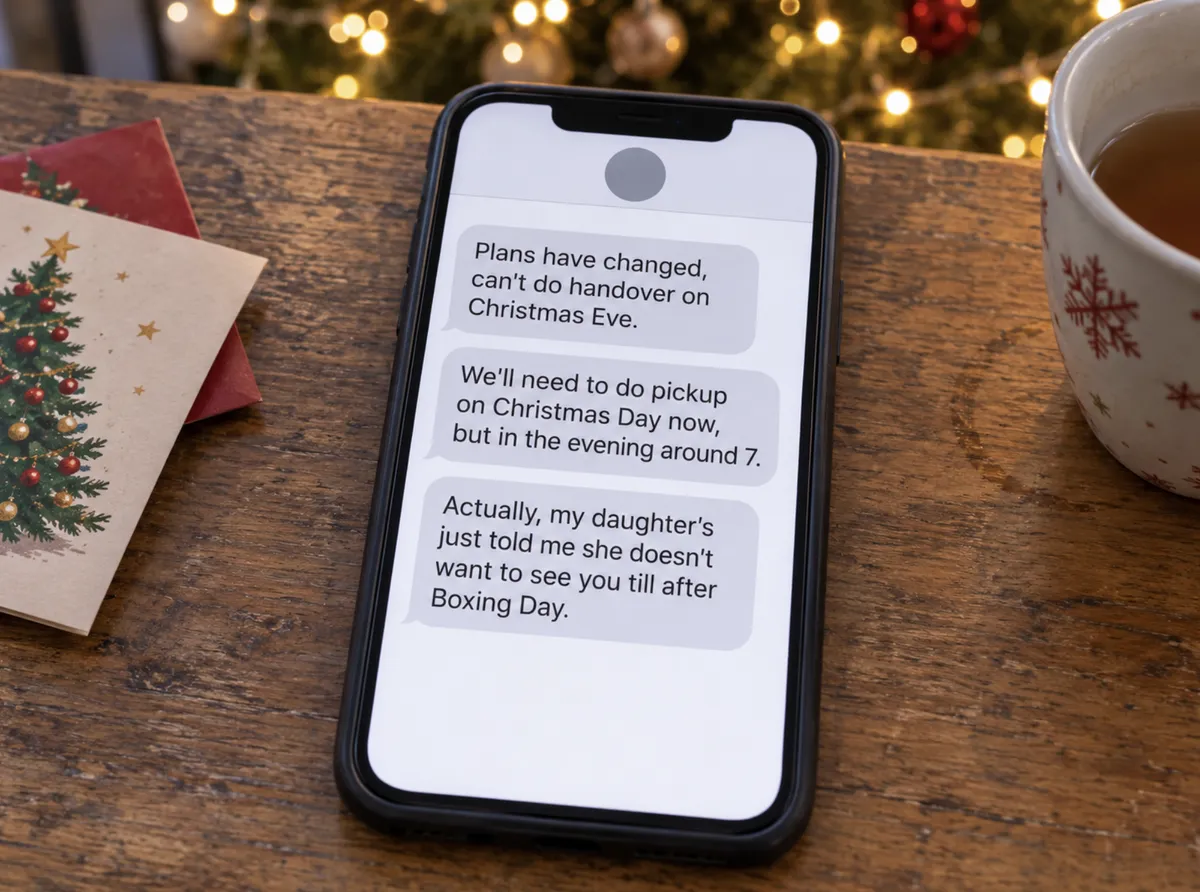
For most separated families, Christmas is a negotiation. For a family where one parent is high-conflict, it is a stage. The arrangements are agreed, then reopened. Christmas Eve plans change on the 23rd. A present you bought appears under the other tree with a different name on the tag. The children come home with a story about what you "refused" to allow. Here is a pattern I see every December in my work with parents who are dealing with a high conflict ex. The weeks before Christmas are full of small provocations, each one easy to dismiss on its own. Together they are designed, consciously or not, to keep you reactive.
Four things about it are widely misunderstood:
It is not about Christmas. The disagreement over who has Boxing Day is rarely about Boxing Day. It is about control, attention or punishment. That is why reasonable compromises often don't end the argument.
You cannot out-argue it. Every long, carefully reasoned reply gives a high-conflict person more material to respond to. Length is fuel.
"Narcissist" is not a diagnosis you need to prove. Whether or not your ex meets any clinical threshold, the behaviour is what matters. Courts and Cafcass look at conduct, not labels.
The children notice far more than you think. They may not read the messages, but they read your face when your phone buzzes.
In short: co-parenting with a narcissist at Christmas is rarely a dispute about dates. It is a pattern of conflict, and the goal is to stop feeding it.
Why is Christmas so hard for children in high-conflict families?
The answer lies in decades of research on children and parental conflict.
In a major review published in the Journal of Child Psychology and Psychiatry in 2018, Professor Gordon Harold and Dr Ruth Sellers brought together the evidence on how conflict between parents affects children. Their conclusion was that frequent, intense and poorly resolved conflict between parents is linked to anxiety, low mood, behavioural problems and difficulties at school. This is true whether parents are together or apart. Their review also showed that it is the conflict, more than the separation itself, that does the damage.
DEFINITION: Interparental conflict
Disagreement or hostility between a child's parents or carers, ranging from tension and silence to arguments, criticism and aggression.
In plain terms: the atmosphere between the two adults your child loves most.
A second strand of research looks at children who feel "caught" between their parents. Paul Amato and Tamara Afifi, writing in the Journal of Marriage and Family in 2006, found that adult children who had felt caught between their parents reported poorer relationships with both parents and lower wellbeing. Being asked to carry messages, keep secrets or pick a side does lasting harm.
DEFINITION: Loyalty conflict
The distress a child feels when they believe that loving or enjoying time with one parent will hurt or betray the other.
In plain terms: your child feeling guilty for having a good time at the other house.
Now think about Christmas. More handovers. Bigger emotional stakes. Grandparents and extended family on both sides with opinions of their own. Presents compared. Questions like "Did you have a nice time at the other house?" or "What did they get you?" asked in a tone the child can read instantly. Cafcass, the service that represents children in family court cases in England, is explicit that parents should never use their child as a messenger. It encourages parents to keep their own reactions in check, keep money and adult issues separate from the children, and work from an agreed plan.
In short: Christmas raises the volume on exactly the two things research shows harm children most: visible conflict and feeling caught in the middle.
What you can control this Christmas, and what you can't
Here's where most parents spend their energy in the wrong place.
What you can't control
Whether your ex sticks to the agreed times.
What they say about you to the children, or to family.
Whether they send a provocative message on Christmas Eve.
How they present the arrangements to anyone else.
What you can control
Whether the arrangements are written down, clearly and early.
How quickly, and how calmly, you respond to messages.
What the handover looks like from your side.
What your children see on your face when they come home.
What your own record of Christmas looks like if anyone ever reviews it.
Put more simply: the second list is the one a court, a Cafcass officer and, most importantly, your children will remember.
The parent who spends December trying to control the first list ends up exhausted and reactive. The parent who puts everything into the second list ends up steady, and steady is what children need.
In short: you can't control your ex's Christmas behaviour, but you have full control over your response, your record and your children's experience of you.
"Why should I be the reasonable one when they never are?"
I understand why it feels that way. You have been reasonable for years. You have bitten your tongue, swapped weekends, paid for things that weren't your responsibility and watched your ex break agreements without consequence. Being told to "stay calm" again can feel like being told to lose quietly. Here's where that feeling comes from. When you are provoked over and over, your nervous system moves into a threat response. Your heart rate goes up, your thinking narrows, and the part of your brain that plans and weighs consequences goes offline. In that state, a sharp reply feels like self-respect. It is often the opposite. It is the reaction the other person was waiting for.
Here is the reframe I give the parents I work with.
You are not being reasonable for your ex. You are being reasonable for your children, and for the record. A family court in England and Wales decides arrangements based on the child's welfare (Children Act 1989, section 1). Where domestic abuse is raised, Practice Direction 12J asks the court to look at the conduct of both parents towards each other and towards the child. Your calm is not a gift to the other parent. It is evidence of who you are as a parent.
The parents who come through high-conflict Christmases well tend to do the same few things. They agree arrangements early and in writing. They answer messages once, briefly, and only about the children. They make handovers boring. And they stop explaining themselves to someone who will never accept the explanation.
EXAMPLE(details combined from several clients and changed to protect confidentiality)
Every year, the message would come on the 22nd or 23rd: a change to the Christmas Day collection time, framed as a favour, with a line about how "the kids will be so disappointed" if it wasn't agreed. Every year this parent would write a long reply, defending the original plan and pointing out every previous broken agreement. This year we wrote one sentence: "Thanks. The arrangement we agreed on 4 November stands: collection at 2pm on the 25th." Nothing else. There was a follow-up message, then silence. Collection happened at 2pm. In January, the parent said it was the first Christmas in four years they hadn't spent arguing in their head.
In short: being the calm parent is not losing. It is protecting your children and building the clearest possible record of who you are.
Your child is watching your face, not the arrangement
This is the part of the conversation almost nobody is having. We put enormous energy into the arrangement: who has Christmas morning, what time the handover is, whether it alternates next year. Those things matter. But for your child, the moment that shapes their Christmas is often much smaller. It is the ten seconds at the door and the expression on your face afterwards.
Children are remarkably sensitive to a parent's stress. In a 2014 study published in Psychological Science, Sara Waters, Tessa West and Wendy Berry Mendes showed that when a parent went through a stressful task and was then reunited with their baby, the babies' own bodies showed a stress response. The infants "caught" their parent's physiological stress, even though nothing had happened to them directly. The researchers called it stress contagion.
DEFINITION: Stress contagion
The transfer of stress from one person to another, measurable in the body, without the second person going through the stressful event themselves.
In plain terms: your child's nervous system picks up on yours, even when you think you're hiding it.
In my clinical experience, this does not stop at infancy. Older children and teenagers are often even better at reading a parent's state, because they have had years of practice. A child coming back from a high-conflict handover is scanning you. If they see tension, they often conclude it was their fault, or that having a good time at the other house was a betrayal. That is a loyalty conflict forming in real time.
DEFINITION: Co-regulation
The process by which a calm adult helps a child's nervous system settle, through tone of voice, facial expression, body language and predictability.
In plain terms: your calm lends your child some of theirs.
This is why I put so much emphasis on what happens in your body before and after a handover. Not because your feelings don't matter, but because your child is reading them.
If you have the children on Christmas Day
Regulate before collection. Ten minutes before you leave, not ten seconds. Slow breathing, a walk, anything that brings your heart rate down. Arrive calm.
Keep the handover short. A warm greeting to the children, a neutral nod to the other parent, into the car. No discussion of arrangements on the doorstep.
Don't debrief them. Let them tell you about the other house if they want to. Respond with simple warmth: "That sounds lovely." Never ask what the other parent said about you.
Give them permission. "It's okay to miss your other parent today. You can call them later." Saying this out loud removes the loyalty conflict.
If you don't have the children on Christmas Day
Make the goodbye clean. Send them off with a smile and no visible sadness. Your grief is real, and it belongs with an adult, not with them.
Plan your own day. An empty Christmas Day with no plan is when the messages get drafted. Fill it with people, movement or rest.
Don't monitor. Avoid checking the other parent's social media for photos. It will not help you, and it may push you into a reaction.
Plan your own celebration. Children are flexible about dates. A "second Christmas" on the 27th can feel just as special if you make it so.
In short: the arrangement decides where your child is at Christmas. Your nervous system decides how they feel about it.
What should you do now?
If Christmas is coming and you are co-parenting with a high-conflict ex, this is where to put your energy in November:
Agree it now, in writing. Times, places, who drives, what happens with presents. Send it once, by email or a co-parenting app, and keep a copy. Cafcass's "Our Child's Plan" template is a good structure.
Pick one channel and one tone. Brief, informative, friendly and firm. Nothing about the relationship. Everything about the children.
Write every message as if a judge will read it. Because one day a Cafcass officer or a judge may.
Never use the children as messengers. Not for times, not for presents, not for "tell your other parent…". Ever!
Script the handover. Same place, same time, same short greeting. Decide in advance what you will say if the other parent tries to start an argument: "I'm not going to discuss that now. I'll reply by email."
Keep a factual record. Date, time, what happened. No adjectives, no commentary. If arrangements are broken, the record speaks for itself.
In short: a calm Christmas with a high-conflict ex is built in November, not on the 24th.
When should you get help?
If you can't agree Christmas arrangements, take advice early. In England and Wales, GOV.UK explains that if you can't agree arrangements yourselves, you can apply to the court for an order, but you'll usually need to show you've considered (or preferably attended) mediation first. Courts are busy in December, so leaving it until the middle of the month may mean nothing is decided in time.
Get support for yourself too if:
you are dreading Christmas so much it is affecting your sleep or your work,
you are drafting angry replies in your head for hours each day,
your children are coming back from the other house anxious, withdrawn or saying things that frighten you,
or you are worried that your own reactions are starting to show.
If at any point you or your children are not safe, contact the police on 999.
In short: if Christmas arrangements are still not agreed in early November, it is time to take advice, and if Christmas is affecting your sleep and your peace, it is time to get support and I would be more than happy to help you.
Frequently asked questions
How do you co-parent with a narcissist at Christmas?
Co-parenting with a narcissist at Christmas works best with structure and minimal contact. Agree arrangements early and in writing, use one communication channel, and keep every message brief, neutral and about the children. Keep handovers short and predictable, and decide in advance how you will respond to provocation. Above all, regulate yourself before handovers, because children are most affected by the conflict and tension they can see and feel between their parents.
Who gets the children on Christmas Day after separation?
There is no automatic rule in England and Wales. Many separated parents alternate Christmas Day each year, split the day, or alternate Christmas Eve and Christmas Day. What matters to the court, if it ever has to decide, is the child's welfare. If you can't agree, you can try mediation and, if needed, apply to the family court, ideally well before December.
What should I do if my ex changes the Christmas arrangements at the last minute?
Respond once, briefly and calmly, referring to the agreement you made in writing. For example: "Thanks. The arrangement we agreed on [date] stands." Don't argue, don't list past grievances, and don't involve the children. Keep a factual note of what happened. If changes keep happening, take legal advice in the new year about formalising arrangements.
Should I tell my children what the other parent has done?
No. Children who are told about adult conflict, or asked to carry messages, often feel caught between their parents, and research links that feeling to poorer wellbeing and poorer relationships with both parents later in life. Keep adult information with adults. If your children ask direct questions, give short, honest, age-appropriate answers that don't criticise the other parent.
How do I stop reacting to my ex's messages over Christmas?
Build a delay into every reply. Read the message, put the phone down, and do something physical before responding. Only reply to what needs a reply. Use a simple test: does this message help my child? If not, it doesn't need to be sent. Many parents find it helps to check messages only at set times on Christmas Day itself.
What is the difference between co-parenting and parallel parenting?
Co-parenting relies on two parents communicating often and making decisions together. Parallel parenting keeps contact between the parents to a minimum: each runs day-to-day life in their own home, and communication is brief, structured and usually written. With a high-conflict ex, parallel parenting often makes Christmas calmer, because there are fewer opportunities for conflict.
Can my ex's behaviour at Christmas be used in court?
It can form part of the picture. In England and Wales, where domestic abuse is raised, Practice Direction 12J asks the court to consider the conduct of both parents towards each other and towards the child. That includes your conduct too. A factual record of broken arrangements, kept calmly and without commentary, is far more useful than angry messages.
Is this post legal advice?
No. This post explains the emotional and practical side of co-parenting with a high-conflict ex at Christmas.
If you're seeking help this time of year, you don't have to wait
If Christmas is already sitting in your chest, it makes sense that you feel this way. You are carrying your children's Christmas and your own case at the same time. But the decisions you make in December, when you are tired and provoked, can shape the year ahead. I work with a small number of parents at a time, helping them stay regulated, child-focused and strategic through high-conflict co-parenting. This isn't a quick chat. It's the first real step towards a calmer year. If this is something you would like to explore I would enjoy talking with you to understand your situation in more depth. You can Book a consultation call with me here.
Rebecca P. Fox
Psychotherapist | Educator | Author
Read more about Rebecca here
IMPORTANT
This article is for educational purposes only. It is not legal advice and is not a substitute for therapy or for advice from a qualified family law solicitor about your circumstances. Family court processes can change. If you are in crisis or feel unable to keep yourself safe, call Samaritans free on 116 123, any time, day or night. If you or your children are in immediate danger, call 999.
References
Children Act 1989, section 1. legislation.gov.uk.https://www.legislation.gov.uk/ukpga/1989/41/section/1
Ministry of Justice. Practice Direction 12J: Child Arrangements and Contact Orders: Domestic Abuse and Harm.https://www.justice.gov.uk/courts/procedure-rules/family/practice_directions/pd_part_12j
GOV.UK. Making child arrangements if you divorce or separate.https://www.gov.uk/looking-after-children-divorce
Cafcass. Communicating with your child's other parent after a separation.https://www.cafcass.gov.uk/parent-carer-or-family-member/my-family-involved-private-law-proceedings/resources-help-you-make-arrangements-are-your-childs-best-interests/communicating-your-childs-other-parent-after-separation
Cafcass. Resources to help you make arrangements that are in your child's best interests.https://www.cafcass.gov.uk/parent-carer-or-family-member/my-family-involved-private-law-proceedings/resources-help-you-make-arrangements-are-your-childs-best-interests
Coram Children's Legal Centre.https://www.childrenslegalcentre.com/
Harold, G. T., & Sellers, R. (2018). Annual Research Review: Interparental conflict and youth psychopathology: an evidence review and practice focused update.Journal of Child Psychology and Psychiatry, 59(4), 374–402.https://doi.org/10.1111/jcpp.12893
Amato, P. R., & Afifi, T. D. (2006). Feeling caught between parents: Adult children's relations with parents and subjective well-being.Journal of Marriage and Family, 68(1), 222–235.https://doi.org/10.1111/j.1741-3737.2006.00243.x
Waters, S. F., West, T. V., & Mendes, W. B. (2014). Stress contagion: Physiological covariation between mothers and infants.Psychological Science, 25(4), 934–942.https://doi.org/10.1177/0956797613518352


