The No-Contact Method: Why Blocking Your Ex Isn't Enough
Toxic Exes Often Get in Touch at Christmas.
Here's Why Simply Blocking Them Isn't Enough, What the No-Contact Method Really Is and How to Do it Successfully.
SUMMARY
Many people who have left a toxic or abusive relationship hear from their ex around Christmas, often with a warm or nostalgic message designed to pull them back in. Most people believe blocking the ex's number is enough to protect themselves. It isn't. The no-contact method is a complete set of steps that removes every route between you and your ex, from photos and messages to mutual friends and social media. Done fully, it tells your mind and your nervous system that this person is no longer part of your life, and it is the first real step of healing.
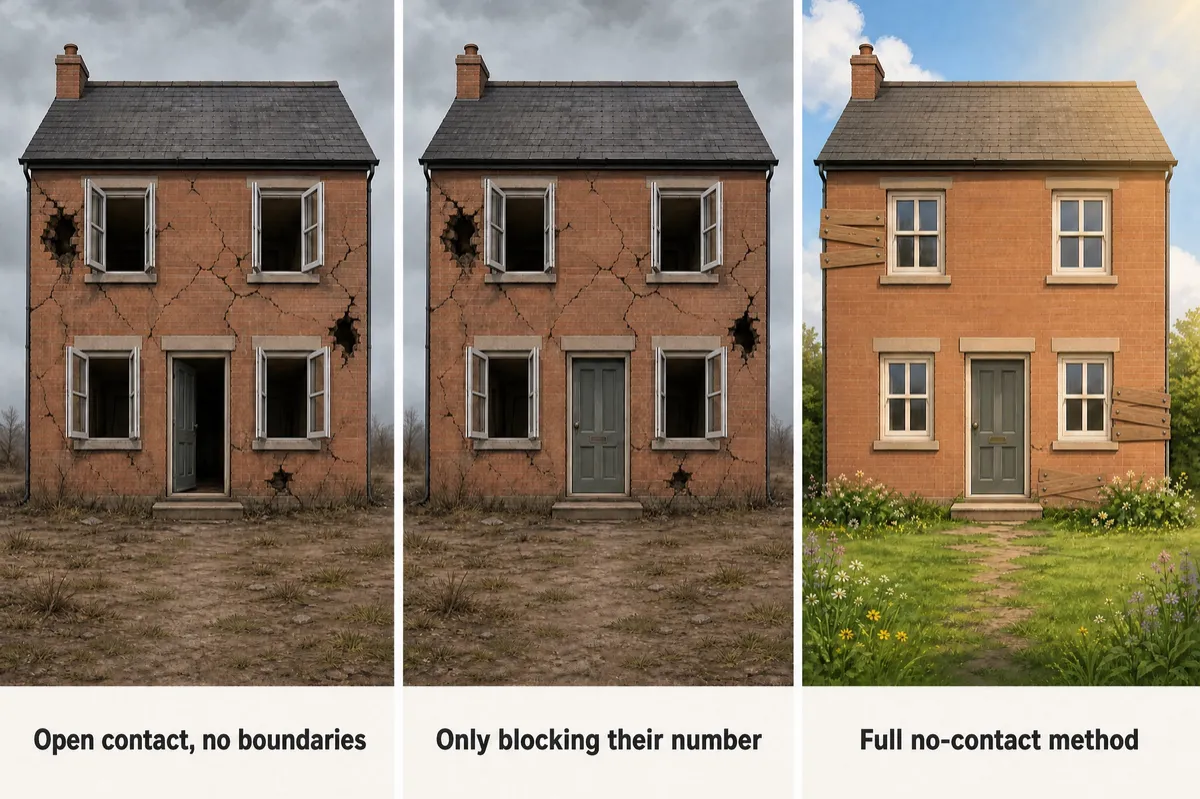
If you've blocked their number and still found yourself checking their profile at midnight, or you've already started bracing yourself for the "Merry Christmas, hope you're well" message, you need to read this. Blocking a number is not going no contact. It is one closed door in a house with every other door and window left open, and at Christmas, a toxic ex will always find the open one.
This post explains why toxic exes get in touch at Christmas, what the no-contact method actually is, what it isn't, and exactly how to do it, step by step, so that this is the Christmas you finally close every door.
What is hoovering?
DEFINITION: Hoovering
A popular, non-clinical term for attempts by a former partner to draw someone back into contact or into the relationship, often after a period of silence, using affection, nostalgia, apology, guilt or a crisis.
At Christmas, hoovering rarely looks dramatic. It looks like "Merry Christmas. Hope you're well." A photo of something you used to do together. A late-night "I miss us." And when you've blocked them in one place, it comes through another: a new number, a different app, a mutual friend, a family member, or a card sent to your parents.
Three things about it are widely misunderstood:
It is not always dramatic. The most effective hoovers look reasonable and harmless. That is why they work.
Replying once doesn't "close" anything. A polite reply is read as an open door.
It reflects their needs, not your worth. It says nothing about whether you matter to them. It says that they want access to you again.
In short: hoovering is an attempt to restart contact after a breakup, and at Christmas it usually looks warm, harmless and easy to answer.
Why do toxic exes get in touch at Christmas?
There are a few reasons this time of year is so common for contact.
Christmas gives cover. A festive greeting is considered socially acceptable. It is very hard for anyone to criticise "Just wanted to wish you a happy Christmas." That makes it a low-risk way to test whether the door is still open.
Christmas triggers nostalgia. Research by Tim Wildschut, Constantine Sedikides and colleagues, published in 2006, found that nostalgia is often triggered by special occasions, music, places and smells, and usually centres on close relationships. Christmas is full of exactly those triggers, which is why a message at this time of year can land so hard.
Intermittent contact strengthens the bond.
DEFINITION: Intermittent reinforcement is a psychological conditioning process where someone receives affection, attention, validation or positive treatment inconsistently and unpredictably. Rather than receiving consistent care, they experience a cycle of rewards and withdrawal, never knowing when the next positive interaction will happen.
In plain terms: in a toxic relationship that unpredictability is what keeps you hooked, and why one warm message at Christmas can pull you straight back in.
In 1993, Donald Dutton and Susan Painter published research inViolence and Victims showing that the unpredictable switching between harm and kindness in abusive relationships was one of the strongest predictors of how attached people stayed after leaving. A warm message out of nowhere at Christmas is intermittent reinforcement in its purest form. It arrives unpredictably, it feels like the good version of them, and it reactivates the bond you have been working so hard to break.
The craving is real. In a 2010 brain-imaging study published in the Journal of Neurophysiology, Helen Fisher and colleagues found that people who had recently been rejected by a partner they still loved showed activity in brain regions linked to reward, motivation and craving when they looked at that partner's photo. A message, a photo or a glimpse of their profile can light up the same systems.
To be very clear: toxic exes never get back in touch at Christmas to apologise because they've changed, or because they're finally taking accountability for what they did. They contact you under the guise of Christmas, knowing you will be more vulnerable and more susceptible to their manipulation tactics. Don't ever confuse the two.
In short: Christmas gives a toxic ex the perfect cover to make contact, and nostalgia and intermittent reinforcement make that contact unusually hard to resist.
What is the no-contact method, and what isn't it?
DEFINITION: The no-contact method
A structured set of steps that removes every route between you and a former partner: photos, videos, messages, phone numbers, social media, and the people around them who could pass information either way.
In plain terms: closing every door, not just the one they knocked on last.
Most people think no contact means just blocking someone's number. It doesn't. Blocking their number while their photos are still in your camera roll, their messages are still in your phone and their best friend, or family members can still see your stories is not no contact. It will backfire every single time, because every open route is a way back in, for them and for you.
What the no-contact method is
Removing every trace of them from your phone, your photos and your social media.
Closing every route of contact, direct and indirect.
Protecting what you share, so nothing reaches them second-hand.
A clear signal, to yourself and to them, that they are no longer part of your life.
What the no-contact method isn't
Blocking their number and leaving everything else as it is.
Keeping their photos or messages "just for now".
Checking their profile from another account, or asking friends how they are.
A tactic to make them miss you or chase you.
Something you implement halfway and hope it works.
Put more simply: no contact is not one action. It is every action, together.
If you have no children or practical ties with your ex, the no-contact method is your only real option for starting the healing process, so you can move on from the toxic or abusive relationship you were in.
In short: the no-contact method closes every route between you and your ex. Blocking a number on its own is not no contact, and it will not work.
Why does the no-contact method work?
In my clinical experience, the no-contact method works on three levels.
It tells your mind you are done. When you take every step and complete the method as it is laid out, you send a clear signal to your mind that you are finished with this person and no longer want them to have any part in your life. That is a huge initial indication, and it is often the first decision in a long time that you have made entirely for yourself.
It teaches your nervous system that you are safe. Going through the method will trigger you emotionally. Deleting the photos, blocking the people, closing the doors: part of you will feel that what you are doing is wrong, or even dangerous, because for a long time keeping them close felt like survival. When you work through those emotions and keep going, two things happen. You find out you have far more strength than you give yourself credit for. And your nervous system notices that despite everything it feared, nothing bad happened. That lesson does not go unnoticed. Pushing through the no-contact method is the first step of your healing journey.
It removes the attachment your subconscious is holding on to. If you don't do this, or you miss some of the steps, you are still allowing that person access to you in some way, shape or form. That signals to your subconscious that there is always a way back, for you or for them. It is why healing takes longer and feels even harder when no contact is only partial: underneath it all, you still feel attached to them. Fisher's brain-imaging research shows why. Every photo you keep and every profile you check can reactivate the craving all over again.
In short: the no-contact method works because it gives your mind a clear decision, gives your nervous system proof that you are safe, and leaves your subconscious nothing to hold on to.
"Isn't this too extreme? Do I really have to delete everything?"
I understand why it feels that way. Deleting years of photos can feel like deleting part of your own life. Blocking their family can feel unkind, especially if you were close to them.
Here's where that feeling comes from. A trauma bond is built to keep you connected. When you start cutting the connection, your nervous system reads it as a threat and pushes back with doubt, guilt and grief. That push-back is not a sign you're doing the wrong thing. It is a sign the method is working.
Here is the reframe I give the people I work with.
You are not deleting your past. You are removing someone's access to your present and your future. The memories stay in your head, where you can process them safely. What goes is the door they keep walking back through.
The people who heal fastest after a toxic relationship are not the ones who feel nothing when they do this. They are the ones who feel all of it and do it anyway.
EXAMPLE(details combined from several clients and changed to protect confidentiality)
They had blocked their ex's number in the summer and called it no contact. By November they were still checking their ex's profile most nights, still had the holiday photos in their camera roll, and still followed two of their ex's closest friends. On Christmas Eve, one of those friends posted a photo with the ex in it, and the whole thing unravelled with my client unblocking them and reaching out. In January we went through the method together, step by step: photos, messages, numbers, friends, family, privacy settings. The first fortnight was hard. They described it as "like pulling something out by the roots". Six weeks later, they said it was the first time since the break-up that their mind felt like their own again.
In short: the no-contact method can feel extreme because the bond was extreme. The discomfort is the method working, not a sign to stop.
How to do the no-contact method, step by step
Give yourself an afternoon or an evening to complete this, be sure to do every step. Missing even one will leave a door open.
Delete every photo and video. Remove them from all your social media channels, your camera roll and your video albums, including any cloud backups, shared albums and "recently deleted" folders. This signals to your subconscious that they are no longer part of your present, nor will they be part of your future. It also signals to your toxic ex, and anyone who knows them, that they are no longer part of your life.
Delete their messages and all communication from them. Texts, voice notes, emails and messages on every app. One important exception: if there has been abuse and you may need those messages as evidence, save them securely before you delete them from your phone. Export or screenshot the full conversations, making sure dates and times are visible, and store them in a password-protected folder on your computer, an encrypted USB stick or external hard drive, or with your solicitor. Keep a second copy somewhere safe. That way they are no longer to hand for you to reread, but they are secure if you ever need to produce them.
Block them, then delete them. Block their number and every social media account, then delete their number and contact details from your phone completely.
Block or restrict their friends and family. Ideally block them, or change their access so they can only see what you choose to share. Any future relationship, plans or personal news should never be able to reach your ex through one of their friends or family. You need to protect yourself on all fronts.
Include mutual friends and your own family where needed. This applies to mutual friends, and to any of your own family members who insist on keeping a friendship or relationship with your toxic ex. Restrict their access to you and what they can see.
Tell your trusted friends and family that you are doing no contact. Let them know the steps you have taken, and make it clear that under no circumstances do you want them to tell you if they have heard from your toxic ex, or to pass on a message from them to you. Part of the no-contact method is having your friends and family on board: people who will not entertain your toxic ex, and who will never act as the messenger between the two of you.
Make every social media account private. Not public, on every platform.
Change your profile picture and name. Use a profile picture that is unrecognisable, or leave it blank, and change your display name, so your ex can't find you or create a fake account to add you.
If they keep finding ways to reach you, change your number. If your ex creates new numbers to contact you after everything else is in place, this is the final step.
In short: the no-contact method is a sequence, not a single action, and every step closes a door that would otherwise let them back in.
What if they won't leave you alone?
Some toxic exes escalate when the doors close: new numbers, new accounts, messages through anyone who will pass them on.
Keep a record. Screenshot messages, note dates and times, and store everything securely, as in step 2.
Know the law is on your side. In England and Wales, repeated unwanted contact can amount to harassment under the Protection from Harassment Act 1997. Controlling or coercive behaviour after a relationship has ended can also be a criminal offence, following a change to the law that came into force in 2023.
Report it. If you are frightened, contact the police. In an emergency, call 999.
In short: if your ex keeps trying to reach you after you've closed every door, record it, and report it.
If you co-parent or have to stay in contact
The no-contact method is slightly different when you have children together. The difference is that all communication happens through a parenting app, and only about the children. Every other step can and should still happen first: the photos, the messages, the social media, the friends and family, telling your own people not to pass messages on, and the privacy settings. Then the parenting app becomes the only door left, and it is a door you control.
Christmas brings its own pressures for co-parents. I've written a separate post on exactly how to handle them: Christmas With a High-Conflict Ex Is Coming. Here's How to Protect Your Children, and Your Case, This Year.
In short: with children, the no-contact method becomes every step except one, with a parenting app as the only route of contact.
What should you do now?
If you've left a toxic relationship and Christmas is coming, this is where I suggest you put your energy:
Start before Christmas. Don't wait for the message to arrive. Put the method in place now, while you are calm.
Do every step. Not most of them. Every single one!
Expect the urge, and ride it out. The pull to check, to look, to reply will come, especially late at night. Each time you ride it out, it gets weaker.
In short: put the full no-contact method in place before Christmas, not after the first message.
When should you get help?
Get support if:
you have tried no contact before and keep breaking it,
you can't bring yourself to start the steps,
or their contact leaves you anxious, frightened or unable to sleep.
If contact ever makes you fear for your safety, call the police. In an emergency, call 999. If you feel unable to keep yourself safe, call Samaritans free on 116 123, any time, day or night.
In short: if you can't start no contact, or can't keep it, it is time to get support.
Frequently asked questions
What is the no-contact method?
The no-contact method is a structured set of steps that removes every route between you and a former partner. It includes deleting their photos, videos and messages, blocking and deleting them on every platform, restricting what their friends, family and mutual friends can see, asking your trusted friends and family never to pass on messages, making your accounts private, changing your profile picture and name, and changing your number if they keep finding ways to reach you. It is not just blocking someone's number.
Is blocking someone the same as no contact?
No. Blocking a number closes one route, but leaves photos, messages, social media, mutual friends and family as ways back in, for you and for them. Partial no contact keeps the attachment alive and tends to backfire, because your subconscious still senses a way back. The no-contact method only works when every step is in place.
Why do toxic exes contact you at Christmas?
Toxic exes often get in touch at Christmas because a festive message gives them cover, the season triggers nostalgia, and an unexpected warm message acts as intermittent reinforcement that reactivates the bond. They are not getting in touch because they have changed. They are using Christmas, knowing you are likely to be more vulnerable to their manipulation.
How do you do no contact when you have children together?
When you have children together, all communication happens through a parenting app and only about the children. Every other step of the no-contact method should still be in place first: deleting photos and messages, blocking and restricting on social media, managing what friends and family can see, and making your accounts private. The parenting app then becomes the only route of contact.
Should I delete messages from my ex if I need them as evidence?
Save them securely first. Export or screenshot the full conversations with dates and times visible, store them in a password-protected folder, encrypted USB stick or external hard drive, or with your solicitor, and keep a second copy somewhere safe. Then remove them from your phone so they are not to hand. Check with a solicitor or the police about what format they need.
Why does no contact feel so hard?
No contact feels hard because a trauma bond is built to keep you connected, and your nervous system reads cutting that connection as a threat. Doubt, guilt and grief are common in the first weeks. When you work through those feelings and keep going, your nervous system learns that nothing bad happened, and the pull becomes weaker over time.
Is this post legal advice?
No. This post is for education and reflection. It is not legal advice, and it is not a substitute for therapy or for advice from a qualified solicitor or the police about your own circumstances. If you are in immediate danger, call 999.
If you're seeking help this time of year, you don't have to do this alone
If the thought of going no contact this Christmas feels overwhelming, I completely understand, and I would be more than happy to help. I always start with a consultation call, so we can talk through your situation in depth. From there, we can explore what working together would look like: putting the no-contact method in place properly, making sense of what happened, and getting you feeling like yourself again.
Book a consultation call with me here. I look forward to speaking with you soon.
Rebecca P. Fox
Psychotherapist | Educator | Author
Read more about Rebecca here
Published 5 December 2026 · Last reviewed 5 December 2026
IMPORTANT
This article is for educational purposes only. It is not legal advice and is not a substitute for therapy or for advice from a qualified solicitor or the police about your circumstances. The law described here applies to England and Wales and may change. If you are in crisis or feel unable to keep yourself safe, call Samaritans free on 116 123, any time, day or night. If you are in immediate danger, call 999.
References
Protection from Harassment Act 1997. legislation.gov.uk.https://www.legislation.gov.uk/ukpga/1997/40/contents
Home Office (2021). Amendment to the controlling or coercive behaviour offence. GOV.UK.https://www.gov.uk/government/publications/domestic-abuse-bill-2020-factsheets/amendment-to-the-controlling-or-coercive-behaviour-offence
Samaritans. Contact us.https://www.samaritans.org/how-we-can-help/contact-samaritan/
Dutton, D. G., & Painter, S. (1993). Emotional attachments in abusive relationships: A test of traumatic bonding theory.Violence and Victims, 8(2), 105–120.https://doi.org/10.1891/0886-6708.8.2.105
Fisher, H. E., Brown, L. L., Aron, A., Strong, G., & Mashek, D. (2010). Reward, addiction, and emotion regulation systems associated with rejection in love.Journal of Neurophysiology, 104(1), 51–60.https://doi.org/10.1152/jn.00784.2009
Wildschut, T., Sedikides, C., Arndt, J., & Routledge, C. (2006). Nostalgia: Content, triggers, functions.Journal of Personality and Social Psychology, 91(5), 975–993.https://doi.org/10.1037/0022-3514.91.5.975


