
YOU'VE KEPT EVERYTHING TOGETHER.
But inside, you're barely holding on

On paper, your life looks fine. Career intact. Responsibilities handled. You show up. You’ve always shown up. But something happened in that relationship, or is still happening - that you can’t quite name. You’re not the kind of person who falls apart.
And yet here you are, feeling like a version of yourself you don’t recognise. Questioning your own memory. Second-guessing your own judgement. Wondering, somewhere in the back of your mind, whether you’re the problem.
Nobody talks about what happens to men in relationships like this.
The narrative around narcissistic abuse, emotional manipulation, and toxic relationships focuses almost entirely on women. The research is written about women. The support communities are built for women. The language of victimhood doesn’t sit easily with most men, and the world does very little to make it easier.
So men in these situations do what they’ve been conditioned to do. They manage. They absorb. They tell themselves it wasn’t that bad. They carry it quietly for years before something finally tips.
If you’re reading this, something in you has already started to surface. Maybe the relationship has ended and you’re still not okay, even though it’s been months. Maybe you’re still in it, and you’ve started to realise that the way it makes you feel isn’t normal. Maybe you’re somewhere in between - out, but not free.
DOES ANY OF THIS SOUND FAMILIAR?
On paper, your life looks fine. Career intact. Responsibilities handled. You show up. You’ve always shown up. But something happened in that relationship, or is still happening - that you can’t quite name. You’re not the kind of person who falls apart.
And yet here you are, feeling like a version of yourself you don’t recognise. Questioning your own memory. Second-guessing your own judgement. Wondering, somewhere in the back of your mind, whether you’re the problem.
Nobody talks about what happens to men in relationships like this.
The narrative around narcissistic abuse, emotional manipulation, and toxic relationships focuses almost entirely on women. The research is written about women. The support communities are built for women. The language of victimhood doesn’t sit easily with most men, and the world does very little to make it easier.
So men in these situations do what they’ve been conditioned to do. They manage. They absorb. They tell themselves it wasn’t that bad. They carry it quietly for years before something finally tips.
If you’re reading this, something in you has already started to surface. Maybe the relationship has ended and you’re still not okay, even though it’s been months. Maybe you’re still in it, and you’ve started to realise that the way it makes you feel isn’t normal. Maybe you’re somewhere in between - out, but not free.
DOES ANY OF THIS SOUND FAMILIAR?
You’ve been told so many times that you’re the problem that part of you has started to believe it
You second-guess your own memory of events - even when you know what actually happened
You’re exhausted in a way that sleep doesn’t fix
You’ve shut down emotionally just to get through each day
You’re still analysing conversations from months or years ago, trying to make sense of them
You feel guilt about things that, rationally, you know weren’t your fault
You’ve lost the version of yourself that existed before this relationship
You don’t fully identify as a ‘victim’ and that word makes the whole thing harder to talk about
You’ve said the words ‘it wasn’t that bad’ to yourself or someone else while knowing, somewhere deeper, that it was
You desperately need to talk to someone but you haven’t, because you’re not sure anyone would really understand
IF THREE OR MORE OF THOSE LANDED - THIS IS FOR YOU

Why most men in this situation don’t get the support they need.
Men who experience emotional abuse, psychological manipulation, or narcissistic behaviour in relationships face a set of barriers that women in the same situation rarely encounter to the same degree. Being told you’re the volatile one. Being the one labelled aggressive or controlling when you try to express yourself. Being dismissed by friends, family, or even previous therapists who don’t fully recognise that men can be on the receiving end of this. Being conditioned, over years, to minimise your own experience until it barely feels real.
And underneath all of it: the shame. The feeling that you should have seen it coming. That you should have handled it better. That a stronger man wouldn’t be sitting here, trying to make sense of something that happened inside a relationship.
You are not weak for not putting up with it any longer. You are not broken for still feeling it. And the fact that you’re here, trying to understand what happened and what to do about it, is not a sign of fragility.
It is the first sign of the kind of clarity that changes everything.
WHAT WAS ACTUALLY HAPPENING AND WHY YOU FEEL THE WAY YOU FEEL
Emotional and psychological abuse in relationships does not leave visible marks. That is precisely what makes it so difficult to identify, so difficult to talk about, and so difficult to recover from.
What it does leave is a set of very specific, very measurable changes to how you think, how you feel, and how you relate to yourself and others.
Cognitive dissonance.
When the person who claims to love you consistently behaves in ways that make you feel unsafe, worthless, or confused, your brain enters a state of cognitive dissonance. It holds two contradictory realities at once - she loves me, and she is hurting me - and works constantly to reconcile them. This is exhausting in a way that goes beyond normal tiredness. It is neurologically depleting.
Identity erosion.
Over time, sustained criticism, gaslighting, emotional withdrawal, and intermittent validation systematically dismantle your reference points. The self-trust you had before the relationship - your confidence in your own perception, your own judgement, your own worth, it gets gradually replaced by chronic self-doubt. This is not a character flaw. It is a predictable response to a sustained pattern of psychological pressure.
Conditioned silence.
Men in these relationships are often trained, over years, to manage their own reactions - to stay calm, absorb, minimise - because expressing anything escalates the situation. By the time the relationship ends, many men have been silent about their experience for so long that they no longer know how to begin speaking about it.
HOW THE WORK ACTUALLY HAPPENS AND WHAT CHANGES AS A RESULT
This is not traditional talk therapy. It is not sitting in a room discussing your feelings indefinitely without a clear sense of direction or measurable progress. My approach combines three evidence-based methods, each targeting a different layer of what the relationship did to you. The process is structured. The progress is measurable. And the goal from session one, is for you to leave stronger and more grounded than when you arrived.
Step 1 - Identify and interrupt the conditioning
Using the Neuro-Change Method™, we identify the specific patterns that were installed over the course of the relationship - the cognitive dissonance, the conditioned responses, the rewired threat detection and we interrupt them at the source. This is not talking about what happened. This is working directly with the neural pathways that are keeping you stuck in reactions, loops, and self-doubt that no longer serve you.
Step 2 - Rebuild your emotional grounding
As a certified EQ-i psychometrics assessor, I measure your emotional intelligence across specific dimensions self-perception, self-trust, decision-making, and stress tolerance. Psychological abuse systematically erodes each of these. This step rebuilds them with precision, so the confidence you develop is not performance-based or temporary. It is structurally grounded and independently verifiable. You will be able to see the change, not just feel it.
Step 3 - Recalibrate and move forward
As a Level 4 Performance Coach, I work with you on the forward-facing work - rebuilding your identity outside of who she said you were, re-establishing your values and your direction, and developing the boundaries and self-trust to ensure you do not find yourself in the same toxic dynamic again. This is the stage where recovery stops being about the past and becomes about who you are now.
Most men I work with see significant, measurable shifts within six weeks. Many continue for three to six months. A small number choose to check in periodically after the core work is done. The timeline is always yours to control.
WHY THE MEN I WORK WITH SAY I UNDERSTAND IN
A WAY THAT OTHERS HAVEN'T

Hi, I'm Rebecca, a UK-based psychotherapist, Level 4 Performance Coach, and the author of Taming Toxic Egos. I am certified in the Neuro-Change Method™ and trained in EQ-i psychometrics which means I work with the neuroscience of what psychological abuse does, not just the narrative of it.
I have spent years working specifically with men who have experienced emotional, psychological, and narcissistic abuse in long-term relationships and marriages. I understand the specific barriers men in this situation face - the dismissal, the self-blame, the silence, the difficulty even framing what happened as something real and serious. I understand it because I have sat with it, professionally and personally.
I also understand why most men who need this support never get it. They can’t find someone who gets it without having to over-explain. They can’t find language that doesn’t feel like it belongs to someone else’s story. They can’t find a space that feels safe enough to speak without being dismissed.
That is the space I have built. And it is specifically for you.
I work globally via Zoom. The consultation call is confidential. Nothing you share goes anywhere. And you do not need to have it all figured out before you reach out - that is what the call is for.
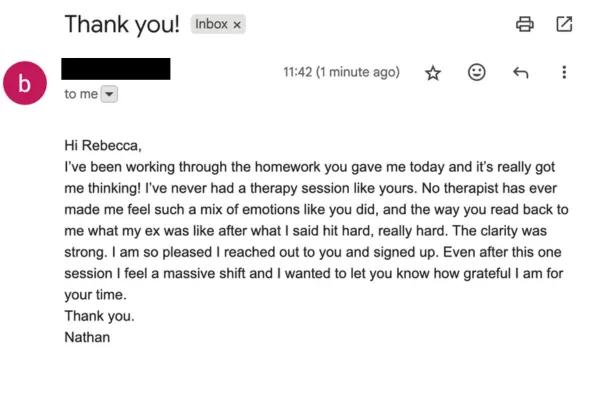
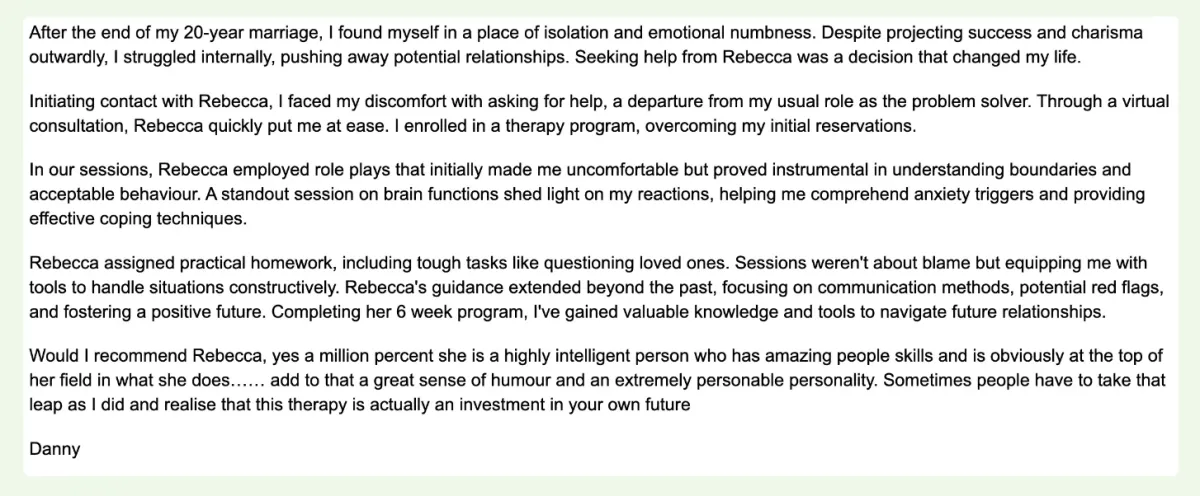
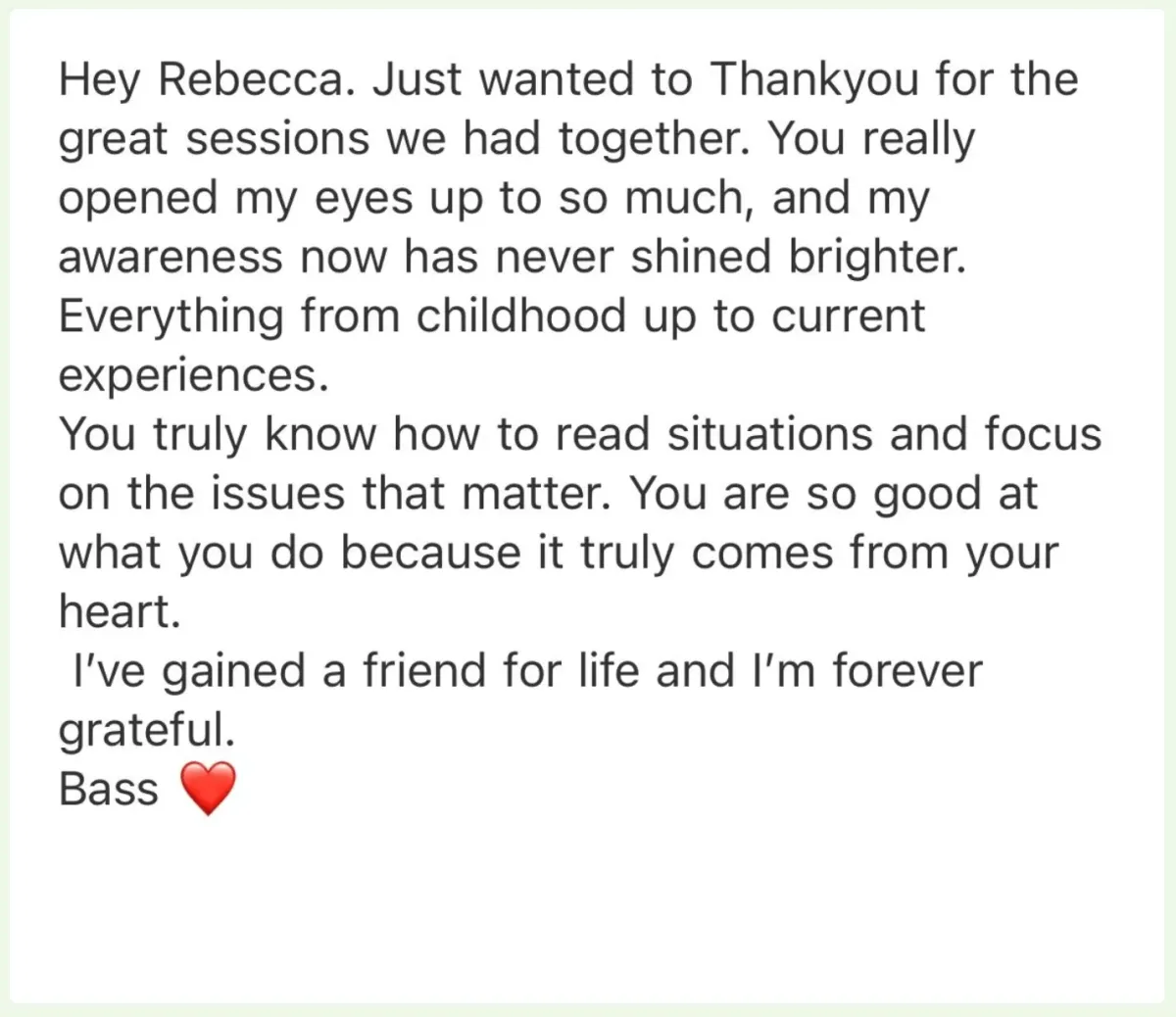
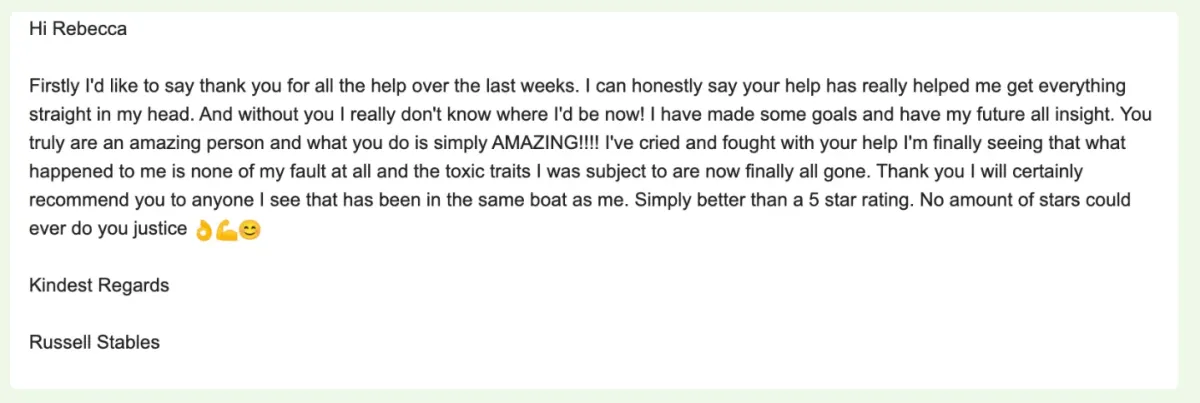
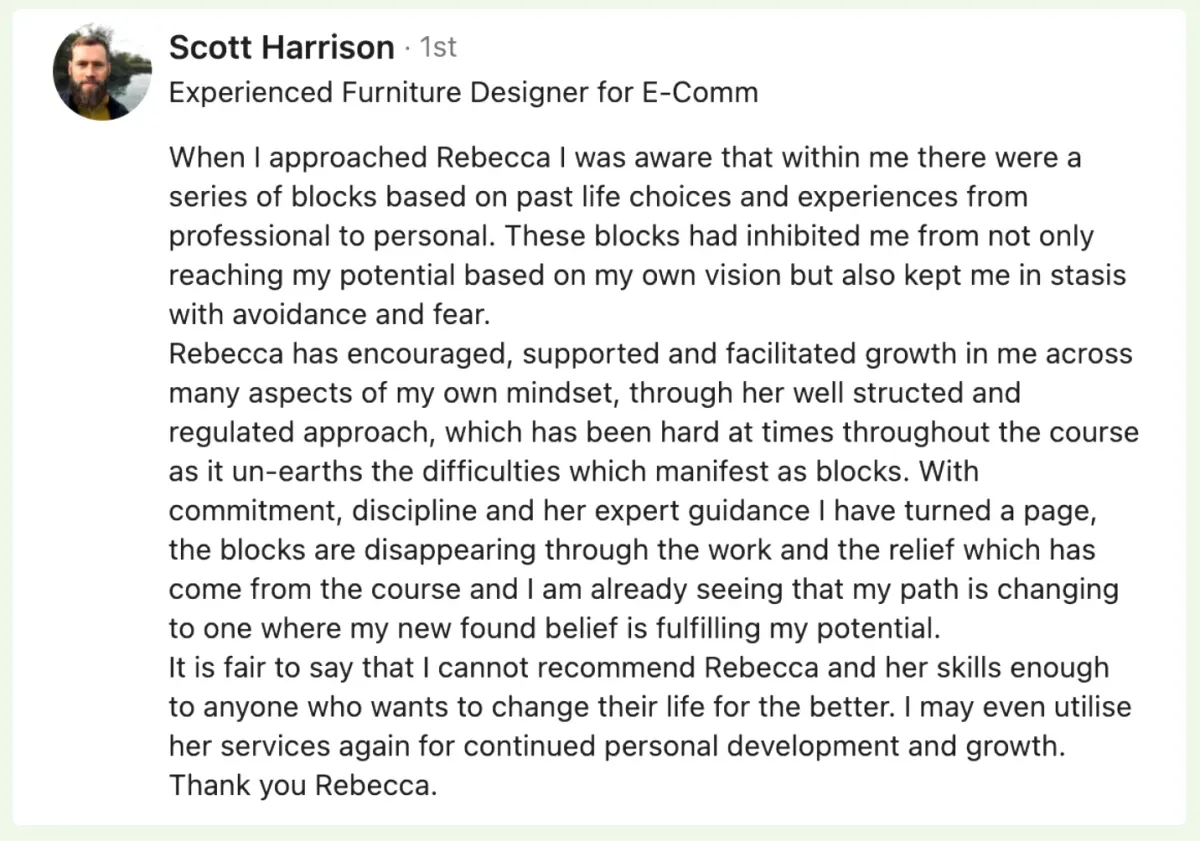
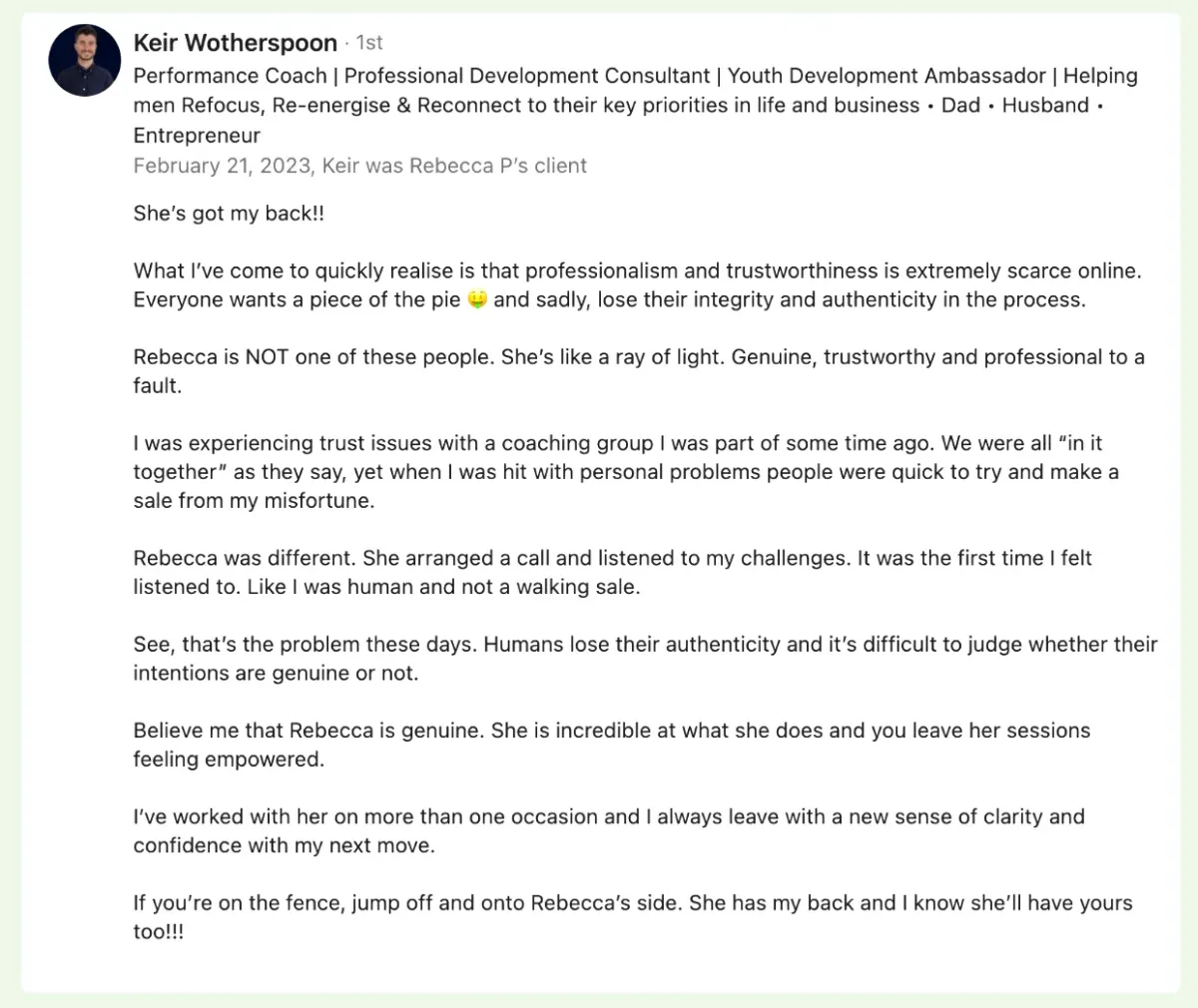
Reviews
Please click each photo to view
© 2025 Rebecca P Fox