
YOU UNDERSTAND WHAT HAPPENED TO YOU
So why do you still feel stuck?
Maybe you’re still in the relationship and you’ve started dreading the sound of his key in the door. You love him. You also find yourself going quiet just to keep the peace. You tell yourself it’s not that bad. And then something happens that reminds you it is.
Or maybe you’re out - separated, divorced, or finally gone - but the relationship is still living inside you. You understand what happened. You’ve read about it, talked about it, maybe even named it. And yet something still hasn’t shifted.
Whichever of those is you right now, you're in the right place
HOW MANY OF THESE APPLY TO YOU?

Maybe you’re still in the relationship and you’ve started dreading the sound of his key in the door. You love him. You also find yourself going quiet just to keep the peace. You tell yourself it’s not that bad. And then something happens that reminds you it is.
Or maybe you’re out - separated, divorced, or finally gone - but the relationship is still living inside you. You understand what happened. You’ve read about it, talked about it, maybe even named it. And yet something still hasn’t shifted.
Whichever of those is you right now, you're in the right place
HOW MANY OF THESE
APPLY TO YOU?
If you're still stuck in it....
You’ve stopped saying certain things because you already know how he’ll react
You walk through the door wondering what mood you’re going to find
You love him, but you’re also frightened of him, and you can’t fully explain either to anyone else
You’ve started questioning whether you’re being too sensitive, too demanding, too much
You used to be good at communicating. Now you don’t know how to talk anymore
You find yourself making excuses for his behaviour - to yourself, to your friends, to your children
Part of you knows this isn’t right. Another part of you is convinced that if you just handle it better, things will change
If you’ve left, but you’re still carrying it...
You know intellectually what happened. You’ve read the books, done some therapy, named the patterns. And yet something still hasn’t moved
You still second-guess yourself in new situations - relationships, friendships, work waiting for the version of you that trusts herself to come back
You’re hypervigilant in ways you weren’t before. Monitoring tone. Scanning rooms. Bracing for something you can’t quite name
There are days you feel strong. And days where something small completely undoes you and you can’t explain why to anyone around you
You’ve watched your children carry the weight of it too. And that is the part that is hardest to sit with
You’re done surviving it. You want to actually be free of it
YOU DON'T HAVE TO HAVE IT ALL FIGURED OUT.
You just have to be at a point where you're done pretending it's fine.

There is a widely held assumption in therapy and in the self-help world: that if you understand what happened to you deeply enough, you will heal from it.
This assumption is wrong! and it is keeping a significant number of intelligent, self-aware women stuck in recovery cycles that should have ended years ago.
Understanding is processed in the prefrontal cortex the rational, language-based part of your brain. It is genuinely valuable. It gives you context, vocabulary, and a framework for making sense of what was done to you. But trauma is not stored in the prefrontal cortex. It is stored in the body. In the nervous system. In the amygdala and the brainstem - the parts of you that operate below language, below conscious thought, and below the reach of insight alone.
When someone repeatedly narrates a distressing experience in detail - which is essentially what talk therapy involves - the nervous system does not always interpret that as resolution. It can interpret it as re-exposure. The threat response activates. Cortisol rises. The body braces.
“If that activation isn’t regulated and integrated, the neural pathway being revisited may actually strengthen rather than dissolve.”
This is not a criticism of therapy. It is a question of mechanism. General counselling is designed to explore meaning and behaviour. Trauma-informed neurological work is designed to recalibrate the nervous system and interrupt conditioned loops. These are different objectives requiring different methods. When someone is still struggling after years of work, the question is almost never: how much more do they need to understand? The question is: has the nervous system actually been addressed?
In my experience - clinical and personal - the answer, most of the time, is no.
DOES THIS SOUND FAMILIAR?
You know intellectually that what he did was abusive. But some part of you still wonders whether you were partly to blame, even when you can’t pinpoint why.
You’ve been told you’ve made so much progress. And you have. But there are still days when something small - a tone of voice, a certain look, a message that goes unanswered sends you somewhere you didn’t expect to go.
You’ve noticed you are hypervigilant in new relationships. You monitor responses. You brace for the inevitable disappointment. You pull away before you can be let down. Or you stay too long trying to earn what you need, because part of you still doesn’t feel worthy of receiving it freely.
You are educated, self-aware, and deeply motivated to heal. And yet your body does not seem to have received the memo.
“You didn’t lose yourself. Someone spent years removing you.”
The confusion. The hypervigilance. The way certain dynamics still pull at you even when you know better. These are not character flaws. They are not evidence that you’re not trying hard enough. They are symptoms of a nervous system that was systematically conditioned and that conditioning can be reversed. That reversal is the work I do. And it is different from anything you’ve probably tried before.
I KNOW THIS BECAUSE I HAVE LIVED IT...

Hi, I'm Rebecca a UK-based psychotherapist, Level 4 Performance Coach, and the author of Taming Toxic Egos. I am certified in the Neuro-Change Method™ and trained in EQ-i psychometrics, qualifications built specifically to address the mechanisms behind trauma, identity erosion, and emotional conditioning at a neurological level.
But the reason I can sit with women in the depths of this experience and understand exactly what they are carrying is not only because of my qualifications. It is because I have been there.
I have experienced abuse so severe that it fundamentally altered how I moved through the world. I know what it is to have your body betray you in ordinary moments, where your chest tightens in rooms you should feel safe in, your throat closes when you try to speak your truth, your nervous system is so primed for threat that peace itself starts to feel unfamiliar.
I know what it is to do years of work and still feel hollow. And I know what it is to finally find a method that actually addresses the right layer and to feel, perhaps for the first time, like yourself again.
That experience shapes every piece of work I do. It means I understand not just the theory of what happened to you, but the texture of it. And it means I will never mistake your progress for completion before it is real.
A METHOD DESIGNED FOR WOMEN WHO ARE DONE
WITH SURFACE-LEVEL SOLUTIONS
Most of what is available for narcissistic abuse recovery falls into one of two categories: general counselling that explores your story without addressing your nervous system, or social media communities that provide validation without transformation.
My approach is neither. It is structured, evidence-based, and measurable - which means you will not simply feel better in session and unchanged in your daily life. You will be able to see, feel, and track your progress across three interconnected layers of work.
Step One - Heal the root cause
Using the Neuro-Change Method™, a scientifically grounded process that works below the level of narrative, we address the trauma at its neurological source. This is not talking about what happened. This is interrupting the conditioned patterns that are keeping you physiologically anchored to the past. This is where lasting change begins.
Step Two - Rebuild your emotional intelligence
As a certified EQ-i psychometrics assessor, I measure your emotional intelligence across specific, targeted dimensions - self-perception, self-expression, interpersonal skills, decision-making, and stress management. Narcissistic abuse erodes each of these systematically. This step rebuilds them deliberately, so that the confidence and clarity you develop is not fragile or performance-based, but structurally grounded.
Step Three - Build the life you actually want
As a Level 4 Performance Coach, I work with you to translate everything you have healed and rebuilt into the relationships, boundaries, and daily reality you want to inhabit. This is where the internal shifts become external ones. This is where healing stops being about your past and starts being about your future.
Most clients work with me for six weeks to six months. Some return for monthly sessions once the core work is complete. My goal is always the same: for you to leave without needing me.
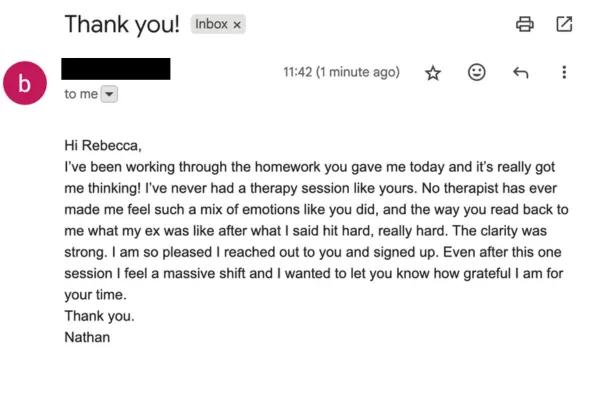
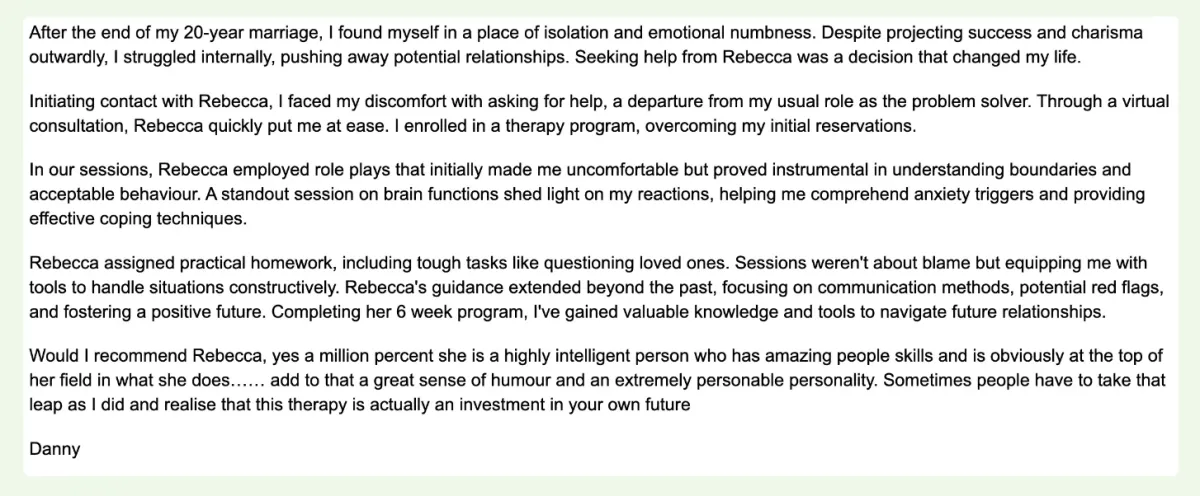
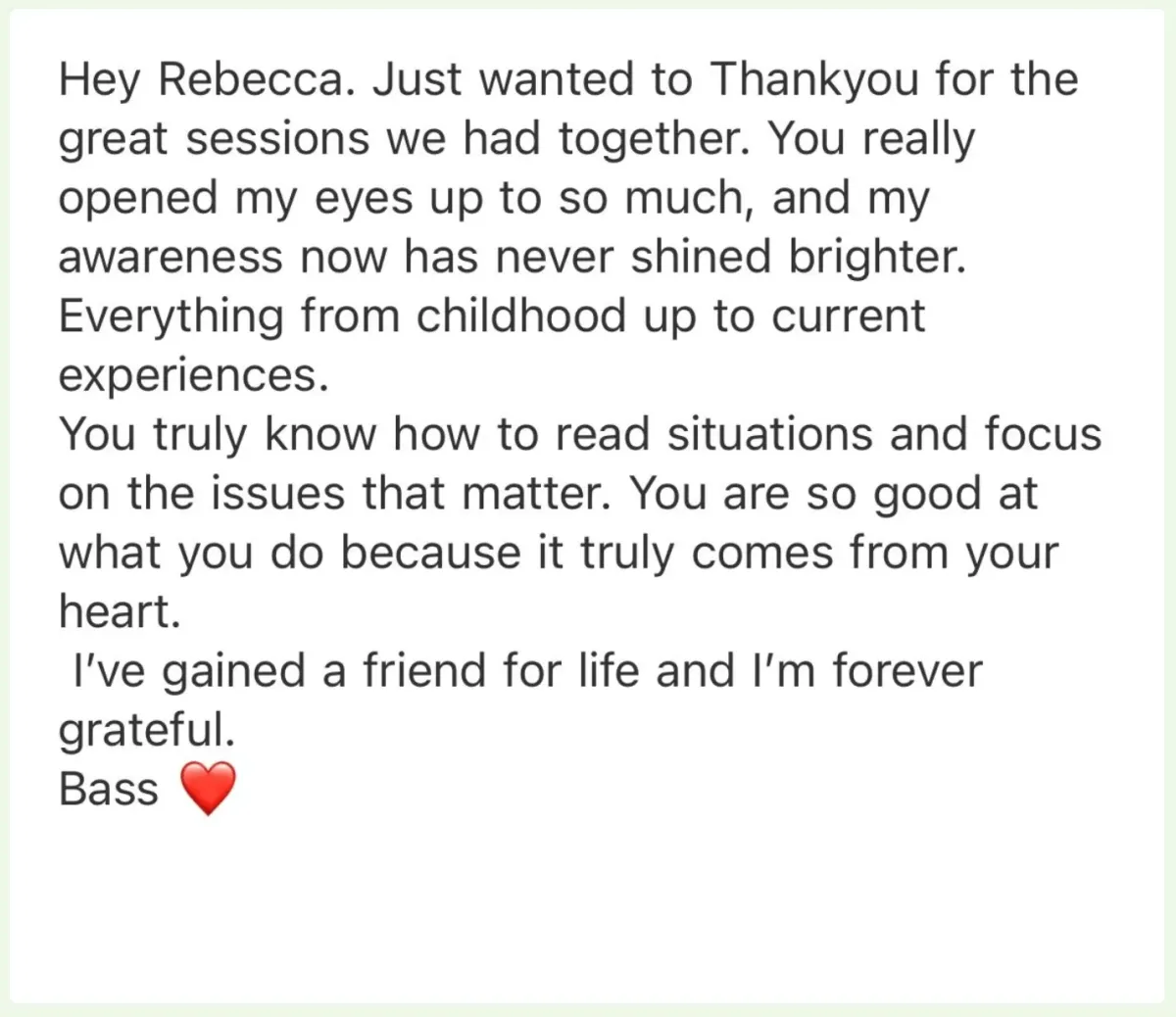
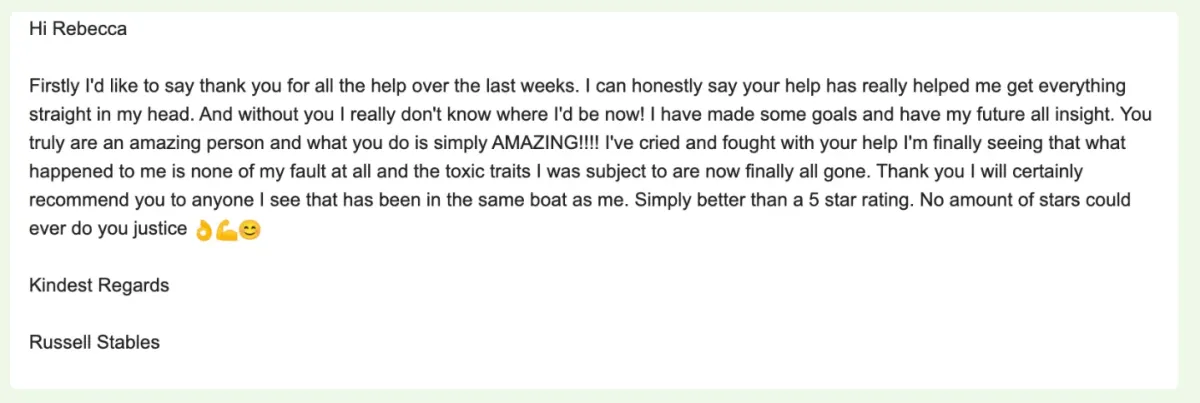
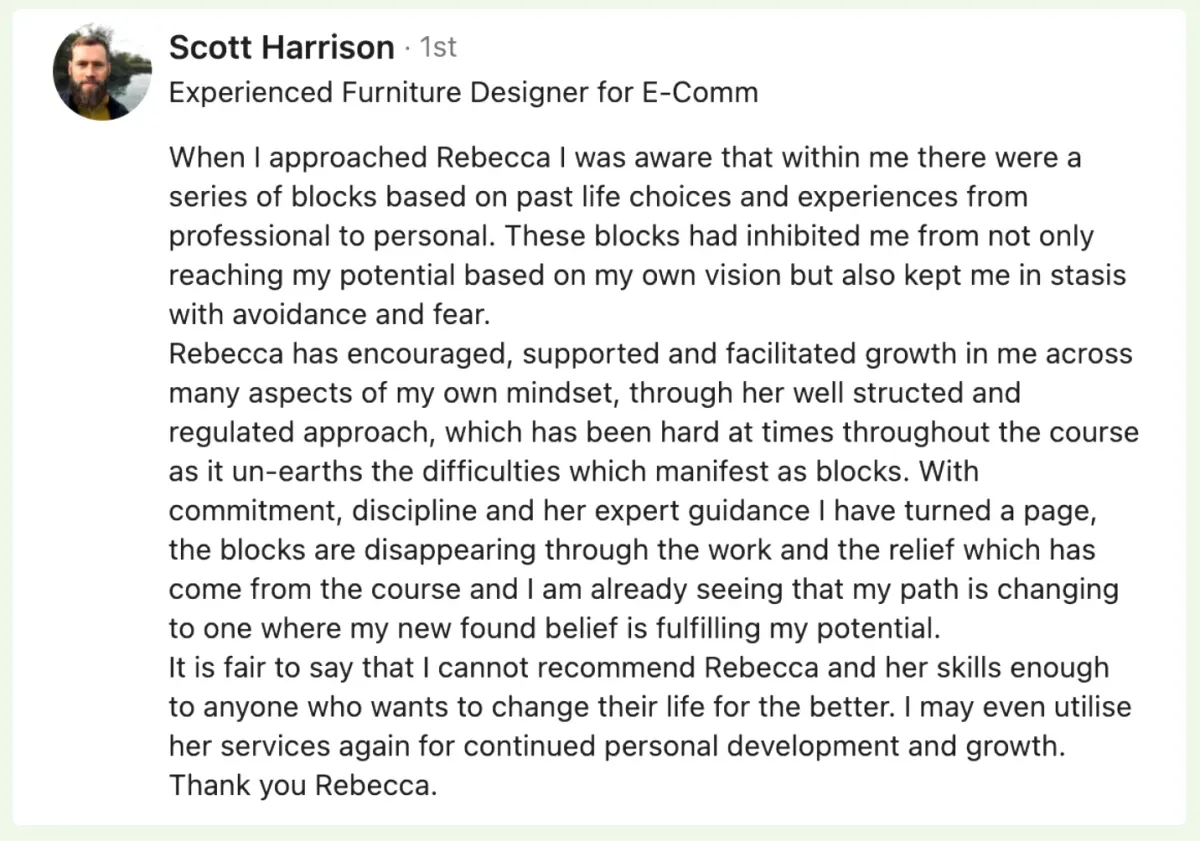
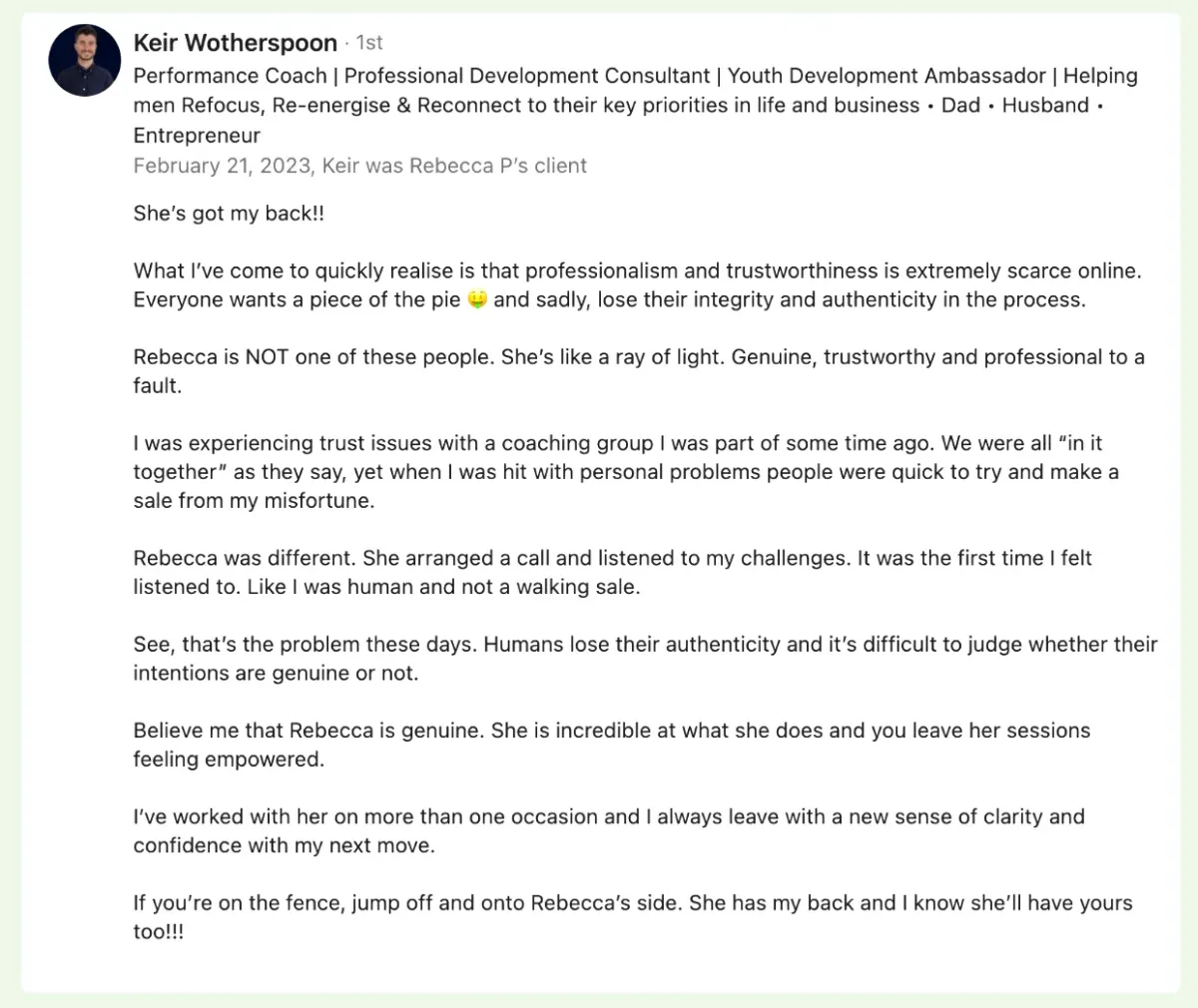
Reviews
Please click each photo to view
© 2025 Rebecca P Fox