
What a Healed Person Looks Like
The Skills of Healing
Summary Healing doesn't mean never feeling pain again. It means peeling back the layers and removing the ones that no longer serve you, whilst building a set of skills that stack one on top of the other. This piece walks through what a healed person actually looks like, why the first step is so hard to take alone, how you start building it, and how your brain rewires along the way.
Quick answer A healed person isn't someone who feels nothing, or who's happy every day. It's someone who's done the work to uncover what caused them harm, and who has built a set of skills - self-awareness first, then boundaries, emotional regulation, accountability, and the ability to walk away from what keeps hurting them. They still feel deeply; they just no longer abandon themselves in order to feel it.
Let's clear something up, because it trips almost everyone up: what a healed person looks like is not what most people picture.
A healed person is not someone who has stopped feeling pain. That image of a serene, unbothered, permanently at peace person isn't a sign of a 'healed' person. Real healing is far more practical, than that. It looks like a person who feels the whole range of human emotion, the difficult ones included, and is no longer swept away by them. Someone who can be hurt without unravelling, disappointed without spiralling, rejected without collapsing.
Here's the part I want you to take most from this, and to have in the back of your mind as you read through this blog: nobody goes through life without experiencing something that is sent to test us, and sometimes to destroy us. None of us are immune from experiencing varying degrees of trauma. We all develop an attachment style in our childhood, and this is based on the relationships and experiences we have with our caregivers and those around us.
Those who have healed are the ones who have faced everything that came their way, including the things that were sent to destroy them. They've worked on every part of it. They've faced what was painful, and they've built a set of skills that mean they're no longer ruled by the past. They can instead grow and thrive towards the future they seek, without behaving in ways that are toxic and cause harm, not only to themselves but to others.
Healing is a set of skills - but it starts with a wound
Healing nowadays gets sold as a set of skills. All you've got to do is communicate your needs, learn to set boundaries, and regulate your emotions. And while, yes, these things are absolutely key to growth, and they're skills that build on top of each other, there's something that gets missed. And it matters more than any of the skills above.
Before you can build anything that holds, you have to go back and address what's underneath: the past traumas, beliefs and conditioning that were handed to you and are still driving your triggers and your discomfort today. Skip that step, and every skill you learn and add on is a plaster over an open wound. It might hold for a while, but the wound is still there, and it will keep reopening. You have to see and explore the wound first, before you can close it. And when you start to build from there, you have a much higher success rate.
In short: Healing is a set of skills, but they only hold once you've addressed the past wounds driving your triggers today - skills bolted onto an unhealed wound are just plasters. First you close the wound; then the skills have something solid to stand on.
It starts with self-awareness
You can't close a wound you can't yet see, and seeing it is what self-awareness gives you. Self-awareness is the ability to notice what's happening inside you as it happens - the trigger, the feeling it sets off, the reaction you reach for, the story you tell yourself about it. Without it, you're driven by patterns you can't see. With it, you finally have something to work with.
Definition of self-awareness Self-awareness is the ability to observe your own thoughts, feelings and reactions as they happen, rather than being unconsciously driven by them. In plain terms: noticing what you're doing while you're doing it, instead of only realising afterwards.
The trouble is, self-awareness is the one skill that's almost impossible to build entirely on your own.
In short: Self-awareness - noticing your triggers, feelings and reactions as they happen is the hardest of these skills to build alone, and there's a good reason why.
Why you can't read the label from inside the jar
Here's how I describe it to my clients: when you're stuck inside the jar, you can't read the label.
You are the one thing you can never quite see clearly, because you're looking out from inside your own patterns. That's why so many people genuinely cannot spot what sets them off, how they react to it, or how that reaction loops round and round with no obvious way out. They're not blind, and they're not broken. They're simply inside the jar - and the label with all the information is on the outside.
This is where a good therapist earns their place. Not to fix you, and not to tell you who to be, but to stand outside the jar and read the label back to you. To point out the blind spots and patterns you were never going to catch on your own. Such as the trigger you didn't know was a trigger, the reaction you assumed was just "how you are," the loop you've been running for years without realising it had a beginning or an end. It's also worth understanding how therapy differs from coaching, because the kind of support that fits depends on where you are.
And once you can see the label - once the pattern is finally visible - something remarkable becomes possible. You can begin to rewire it. The trigger that used to hijack you starts to lose its grip. The automatic reaction stops being quite so automatic. You get to choose a different response, and with enough repetition, the new response becomes the natural one.
In short: You can't see your own patterns clearly from inside them - you can't read the label from inside the jar - which is why a therapist, standing outside it, helps you spot your triggers and then rewire them.
How you actually start building self-awareness
You don't build self-awareness by trying harder to "be aware." You build it by slowing down the gap between what happens and what you do next. A few things genuinely help you begin, even before you've got someone standing outside the jar with you:
Name the trigger. The moment you can say "that comment just made me feel small," you've stepped half an inch outside the jar.
Watch the reaction rather than only having it. Notice the urge to snap, withdraw, over-explain or fix before you act on it. That noticing is a whole skill on its own.
Get curious about the loop. Ask what the reaction is trying to protect. Most of them would have made complete sense once, in a situation that's long gone.
Write it down. Patterns are far easier to read on paper than in the middle of feeling them.
None of this replaces having someone outside the jar with you - that's what makes the blind spots visible fastest, but it's how you start turning the label towards the light.
In short: You start building self-awareness by slowing the gap between trigger and reaction, by naming the trigger, noticing the urge before you act, getting curious about the loop, and writing it down.
The knock-on effect: what a healed person can actually do
Once self-awareness is in place, the other skills begin to stack on top of it. This is the knock-on effect - each skill making the next one possible. Over time, a healed person becomes someone who can:
Communicate their needs - confidently, without hinting, sulking, or hoping someone will guess.
Set boundaries without guilt - saying no without a paragraph of justification, or days of self-reproach afterwards.
Regulate their emotions - feeling something fully without being run by it.
Accept rejection - hearing "no" without it becoming a verdict on their entire worth.
Take accountability - owning their part without collapsing into shame.
Walk away from what repeatedly harms them and actually stay away.
Definition of emotional regulation Emotional regulation is the ability to feel an emotion fully and choose how you respond to it, rather than being controlled by it or shutting it down. In plain terms: You feel it fully. You just decide what to do with it, instead of it deciding for you.
Notice what sits underneath every one of these: self-awareness. You can't set a boundary you can't feel forming. You can't regulate an emotion you can't name. You can't walk away from a pattern you can't see. Each of these skills grows out of that first one.
And here's the distinction that matters most. A healed person hasn't gone numb. They still feel deeply - the love, the grief, the anger, the joy, all of it. What's changed is that they no longer abandon themselves in order to feel it. They can stay with their own experience and honour someone else's. They can be moved without being swept away.
In short: Once self-awareness is in place, the other skills stack on top - communicating needs, boundaries without guilt, emotional regulation, accepting rejection, accountability, and walking away from harm, and a healed person still feels deeply, they just don't abandon themselves.
Your brain is built to change - mindset and rewiring
None of this would be possible if the brain were fixed. But the truth is, it isn't. Your brain is capable of rewiring itself throughout your entire life.
In fact, it already has. The trauma you experienced, the toxic relationship you were subjected to: those experiences rewired your brain. You were rewired for protection rather than connection, for bracing rather than trusting. That wasn't a flaw or a weakness. It was your brain doing exactly what it is built to do, keeping you safe in an environment that wasn't.
And here is the hope in that: a brain that rewired itself once can rewire itself again. Every time you practise a new response instead of the old automatic one, you strengthen a new pathway. Repeat it often enough, and it becomes the road your mind travels to by default.
Definition of neuroplasticity Neuroplasticity is the brain's ability to change itself throughout life, forming new connections and weakening unused ones in response to what you repeatedly think and do. In plain terms: your brain is rewireable, at any age.
Mindset is what keeps you doing the repetitions. A growth mindset - the belief that you can change, that you are not a finished, fixed thing, isn't motivational fluff. It's the belief that keeps you showing up to practise, and practice is what lays down the new wiring. A fixed mindset ("this is just how I am") quietly closes the door before you've even tried. A growth mindset holds it open long enough for the rewiring to happen.
Definition of a growth mindset A growth mindset is the belief that your abilities and responses can develop through effort and practice, rather than being fixed traits you're stuck with. In plain terms: "I can learn to do this," not "this is just how I am."
In short: The brain rewires through repetition, and a growth mindset believing you can change, is what keeps you practising the new response until it becomes the automatic one.
Fixed mindset vs growth mindset
The quickest way to spot which one is running the show is to notice what you believe about change itself.
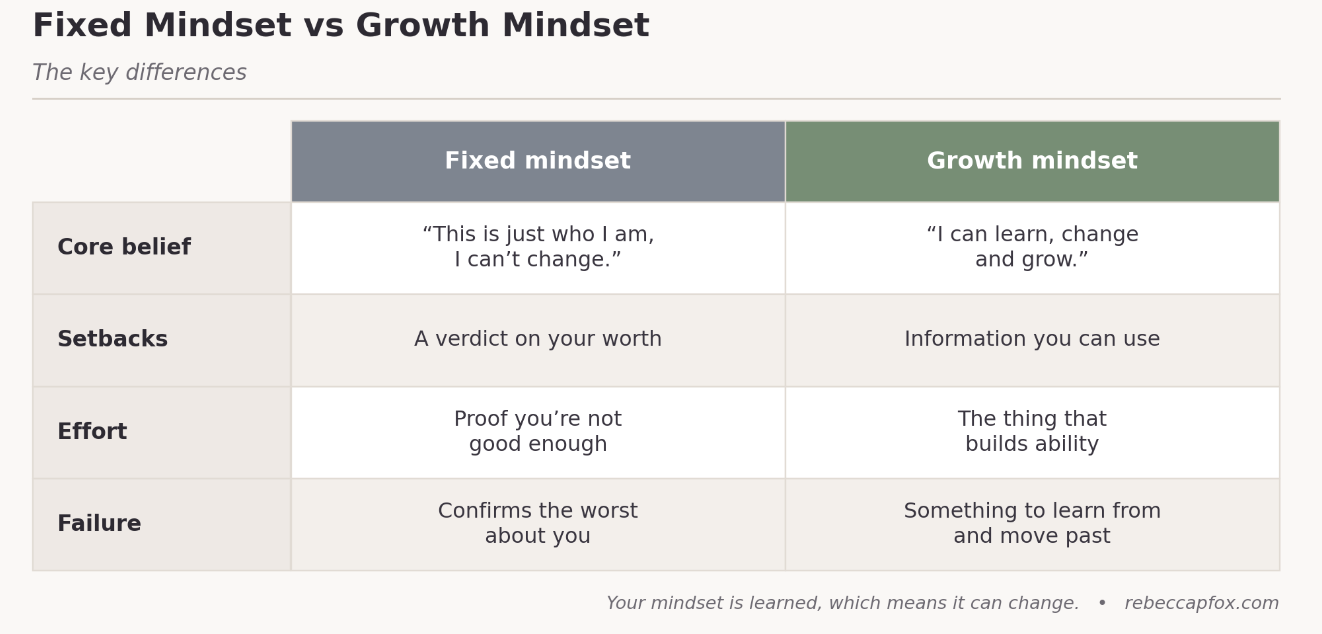
A fixed mindset rarely comes from nowhere. In my work, I see it again and again in people healing from trauma or unhealthy relationships. The belief that you can't change isn't something you were born with. It was learned, often early, from experiences and relationships that taught you it was safer to stay small.
And what was learned can be unlearned. That is the whole point of the rewiring we just talked about. As you move towards a growth mindset, you become more resilient. Not untouched by setbacks, but far less knocked down by them, and far quicker to get back up.
In short: A fixed mindset says "I can't change" and treats setbacks as verdicts; a growth mindset says "I can grow" and treats them as information and because the fixed belief was learned, it can be rewired.
Healing is a journey, not a destination
I won't pretend there's a finish line where you're declared healed and never struggle again. There isn't. Healing is an ongoing practice, not a prize!
But something genuinely shifts once the foundations are in. You're no longer plagued by reactions and responses you can't control, or consumed by emotions that swallow you whole. Your mental health settles into something steadier and more balanced.
That word balanced is the honest goal, not relentless happiness. You'll still have days when you feel sad, flat, or tender, and that isn't a relapse. That's being human. Nobody lives a consistently happy life, every single day, and chasing that is its own kind of trap. What healing offers isn't permanent sunshine. It's balance - the ability to move through the hard days without being undone by them, and to find your way back to yourself more quickly each time.
In short: Healing is an ongoing journey, not a fixed destination - the goal isn't relentless happiness but balance, where sad days are part of being human rather than a sign you've failed.
If this sounds like the work you're ready for
If you've read this and recognised yourself, stuck inside the jar, running loops you can't quite see, tired of reactions that don't feel like a choice - then notice this: that recognition is itself the very first flicker of self-awareness. It's the beginning of your healing journey!
This is the work I do with clients: helping you read the label from outside the jar, spot the patterns you were never going to catch alone, and rewire the triggers that have been quietly running the show. Healing was never about becoming someone else. It's about becoming so steadily yourself that you no longer abandon yourself to keep everyone else comfortable.
If you'd like to talk about where you are and what that work could look like for you, you can book a call with me through my website. I'd be glad to help you take the first step out of the jar.
Rebecca P. Fox
Psychotherapist | Educator | Author
Frequently asked questions
What does a healed person actually look like? Not someone who never feels pain, or who's happy all the time. A healed person feels the full range of emotion but is no longer run by it - they can communicate their needs, set boundaries without guilt, regulate their emotions, accept rejection, take accountability, and walk away from what repeatedly harms them. They still feel deeply; they just don't abandon themselves.
Is healing something you learn, or something you're born with? It's a set of learnable skills, not a fixed personality. They build on one another, starting with self-awareness, and grow stronger with practice - which is also how the brain gradually rewires itself.
How do you start building self-awareness? Slow down the gap between what happens and what you do next. Name the trigger when you feel it, notice the urge to react before you act on it, get curious about what that reaction is protecting, and write your patterns down. A therapist speeds this up considerably, because they can see the blind spots you can't.
Why do I need a therapist to heal - can't I do it alone? You can do a great deal of the work yourself, but self-awareness is genuinely hard to build alone, because you can't see your own patterns clearly from inside them - you can't read the label from inside the jar. A therapist stands outside it, reflects your blind spots and patterns back to you, and helps you rewire the triggers you couldn't spot on your own.
Does being healed mean I'll be happy all the time? No, and that's an unrealistic, unhelpful goal. Healing brings balance, not permanent happiness. You'll still have sad or flat days; that's part of being human. The difference is that they no longer consume you or knock you off course for long.
How does mindset affect healing? A growth mindset - believing you can change rather than being stuck as you are keeps you practising new responses. That repetition is what strengthens new pathways in the brain, so the healthier response gradually becomes the automatic one.
Can you really rewire your triggers? Yes. Once a trigger and your reaction to it become visible, you can practise a different response. With repetition, the old automatic reaction loses its grip and the new one becomes more natural - this is the brain's capacity to change at work.
About the author
Rebecca P. Fox - Psychotherapist | Educator | Author. Rebecca helps people recover from toxic and abusive relationships, navigate high-conflict co-parenting, and build the self-awareness and emotional skills that healing is made of.
This article is educational and isn't a substitute for therapy or a diagnosis. If you're struggling, you don't have to face it alone in the UK you can contact Samaritans free, day or night, on 116 123.
References
Dweck, C. S. (2006). Mindset: The New Psychology of Success. Random House - the concept of fixed versus growth mindset.
Hebb, D. O. (1949). The Organization of Behavior - the origin of the principle often summarised as "neurons that fire together, wire together," which underpins how repeated responses strengthen neural pathways.


